UK Residential Proxy: Geo-Targeted Access & YouTube API 2026
Get reliable geo-targeted access with a powerful uk residential proxy. Seamlessly integrate with YouTube Download API workflows and unlock expert tips for 2026.
Dalvo · August 10, 2026
Your dev team has the YouTube ingestion feature almost working. The API returns metadata, but the actual download job keeps stalling on region-locked videos, and every fallback path ends up looking like the same problem, a UK-only result that won't behave like a real UK household connection. That's the point where a UK residential proxy stops being a nice-to-have and becomes part of the engineering design, especially when the target site cares about locality, browser trust, and consumer-IP provenance.
Table of Contents
- Introduction to UK Residential Proxies
- Understanding UK Residential Proxies
- Common Use Cases for UK Residential Proxies
- Performance Reliability and Detection Risks
- Legal and Ethical Considerations
- Selection and Evaluation Checklist
- Integration Tips and Recommended Metrics
- Conclusion and Next Steps
Introduction to UK Residential Proxies
The first sign that your setup needs a UK residential proxy is usually boring and repetitive. A script that works from your office network starts returning geo-restricted responses, or your YouTube download flow behaves differently when the request lands outside the UK. That's not a parser bug, it's a location signal problem.
UK residential pools matter because they present as genuine home-user traffic, not cloud-hosted infrastructure. In practical terms, that can mean fewer immediate blocks on geo-sensitive pages and a better chance of seeing what a British user actually sees, which is the whole point of localized fetching and ingestion. The UK also has the housing and internet scale to support meaningful proxy inventories, so this isn't a niche corner case, it's a mature operational market built on consumer broadband and household connections.
When teams use proxies in video workflows, they're usually not trying to “beat” a platform. They're trying to get consistent access, stable metadata, and reliable download URLs without fighting constant trust checks. That's why the engineering question isn't whether proxies exist, it's whether the proxy layer matches the geography and legitimacy profile the target expects.
Understanding UK Residential Proxies
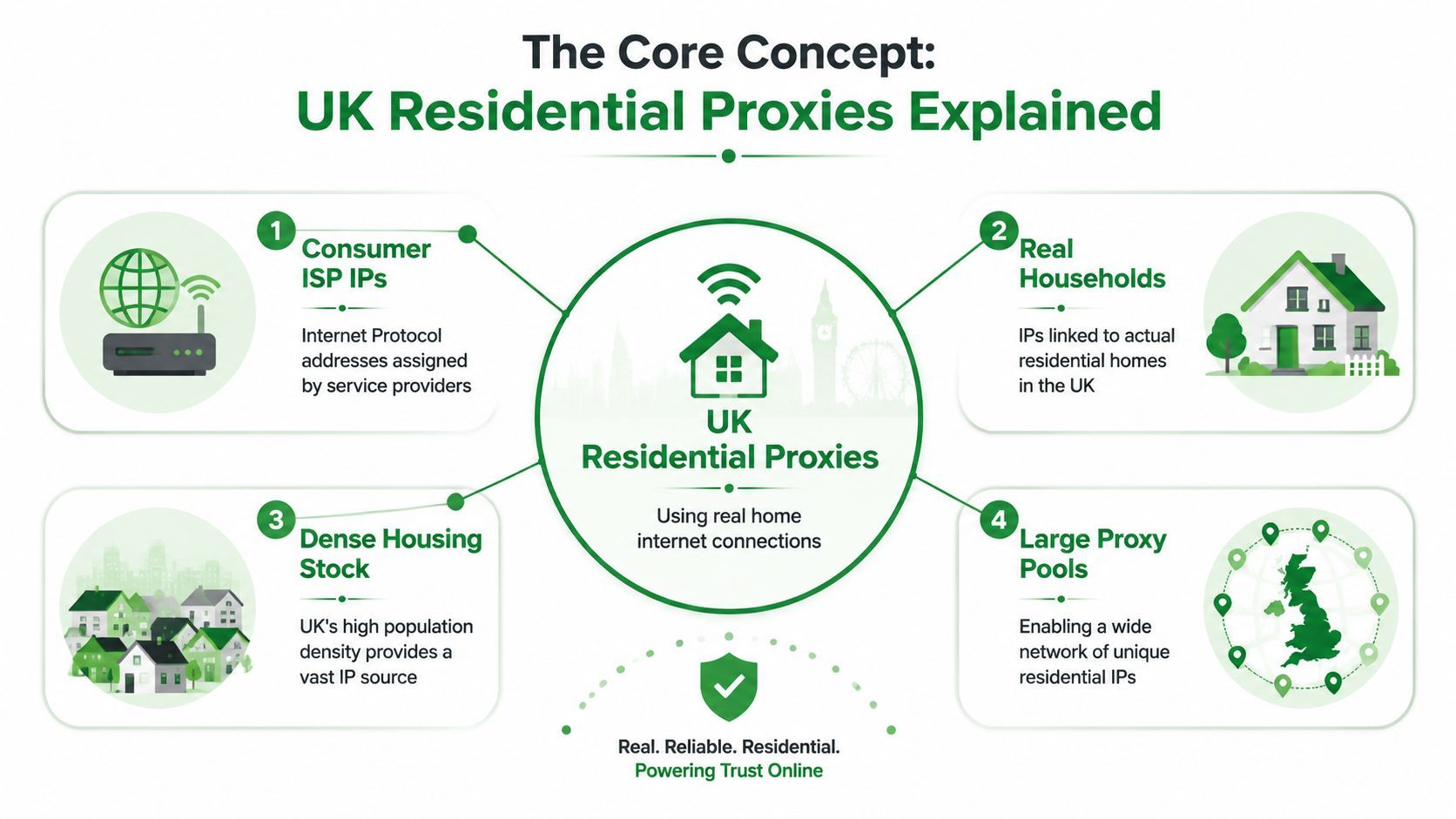
A UK residential proxy is defined by IP provenance. The exit IP comes from a consumer ISP connection assigned to a real household, so the traffic looks residential instead of datacenter-originated. That classification matters because geolocation and fraud systems often treat home-broadband ranges as more legitimate than cloud ranges, which can reduce friction on UK-gated pages and login-sensitive workflows. Independent guidance also recommends checking the same UK IP against multiple databases, because city lookups can disagree even when the country stays stable. See the discussion of lookup consistency in this proxy engineering guide on UK geo access.
Why the UK can support large proxy pools
The underlying market is large enough to make this practical. The UK population was about 67.6 million in mid-2024, and England alone had 25.4 million dwellings in 2023, including 15.9 million owner-occupied homes and 5.3 million privately rented homes (ONS housing and population data). Those household connections are the raw material for residential proxy networks, which is why UK-only inventories can be commercially meaningful.
Recent pool measurements show the practical scale. One provider reported a real-time active IP pool of 35,938 UK residential IPs, 60,689 unique IPs in the last 24 hours, and 211,356 unique IPs in the last 30 days (provider UK pool figures). Another reported 1M+ active UK IP addresses, 99.95% network uptime, and 15 ms average response time across 10+ UK cities (same provider location page). That's enough to support serious geo-targeted access, not just casual testing.
Where residential, datacenter, and mobile differ
Residential proxies are the default when the site is sensitive to consumer-IP legitimacy. Datacenter proxies are cheaper and faster in many cases, but they're easier for targets to classify as infrastructure traffic. Mobile proxies sit in a different category again, because they use carrier-grade IPs and can be better for app-like behavior or highly defended endpoints.
Practical rule: use residential when the target cares about consumer trust, mobile when the target behaves like a phone user, and datacenter only when the page is open enough that reputation doesn't matter.
The trade-off is straightforward. Residential improves acceptance on protected endpoints, but it usually means slower handshakes and more session variance. Datacenter gives you raw simplicity, but it often won't surface the localized UK output you require. Mobile can be strong on legitimacy, though it's usually a heavier operational choice and not necessary for every workflow.
Common Use Cases for UK Residential Proxies
A UK residential pool earns its keep when the output changes by geography. That's true for pricing pages, regional availability, branch coverage, and search results, and it's just as true when a YouTube-related workflow needs the request to behave like a real British session. If your team is extracting metadata, resolving download links, or checking whether region-specific content is available, the proxy layer isn't decoration, it's part of the data path.
Geo-testing and localized UX checks
For QA and product teams, the obvious use case is verifying that a site shows the right UK content. That includes GBP pricing, UK delivery options, regional stock, and any interface copy that changes by location or carrier. The useful part isn't just “does the page load,” it's “does the page behave like it would for a user in Manchester, Glasgow, or Belfast.”
Scraping public and gated data
Residential proxies are also common in public data collection when the target gives different responses to different IP classes. Market teams use them for ad verification, competitive intelligence, and price monitoring, but the right decision still depends on the target's risk posture and site terms. The strongest engineering pattern is to reserve residential for endpoints where correctness depends on appearing local, and use simpler infrastructure everywhere else.
YouTube workflows that need UK context
For YouTube-specific ingestion, the edge cases are usually about geography and trust. A video may be available in the UK but not elsewhere, the metadata may vary by region, or the download path may trigger extra scrutiny when the request doesn't resemble a normal UK consumer session. A residential proxy can help the request land in the right locality, which is often the difference between a clean retrieval and a failed job.
This is also where proxy choice needs to stay disciplined. You don't need a heavyweight proxy stack for every media task, and you don't want to rotate unnecessarily if the download flow benefits from session consistency. If your team is building around search discovery or query-heavy lookup patterns, the proxy design should stay close to the actual request shape. The Google proxy selection guidance is useful because the same locality and trust constraints show up in adjacent discovery workflows.
Operational takeaway: if the data varies by UK locality, use a UK exit. If the workflow is simple and open, don't add proxy complexity just because you can.
Performance Reliability and Detection Risks
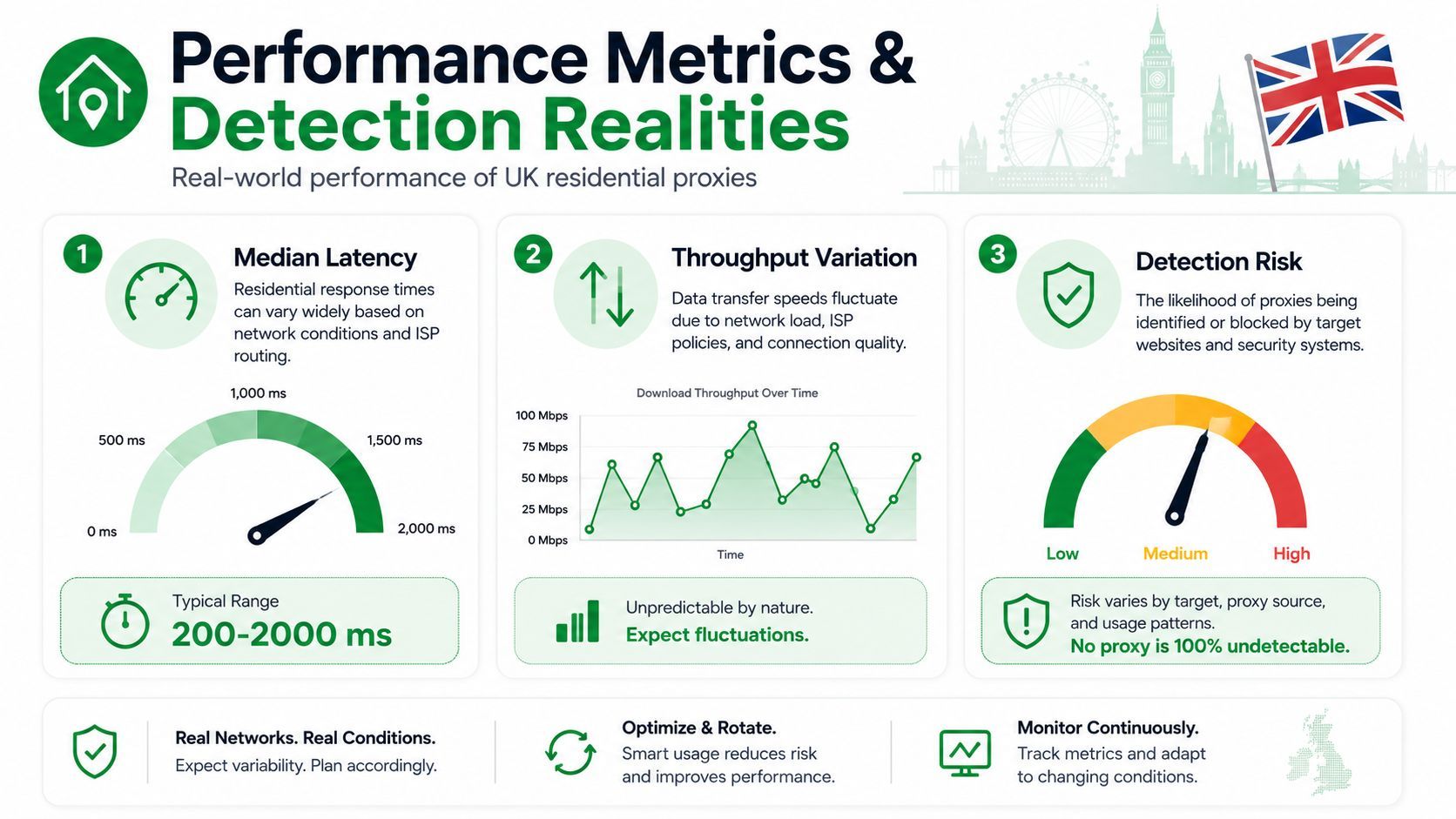
Performance is where teams often get surprised. A UK residential proxy can be the right legitimacy layer and still feel slower than expected, because the main constraint is usually latency and throughput variance, not reachability. One UK residential source reports median response times in the 200 to 2000 ms range, with sub-500 ms connect time as a common benchmark (coronium mobile proxy performance notes).
What slow really means in practice
For a single request, a few extra hundred milliseconds may not matter. For a queue-driven ingestion workflow, it changes concurrency planning, retry behavior, and how many jobs you can safely keep in flight. If the proxy layer has jitter, your async job model needs to tolerate inconsistent completion times instead of assuming a neat linear path.
A separate UK mobile proxy reference reports 10 to 100 Mbps throughput, 30 to 60 ms latency to UK targets, and 99.9% uptime on carrier-grade mobile IPs (same performance reference). That comparison is useful because it shows why mobile can outperform residential on some defended paths, even if residential remains the better fit for many browser-like sessions. The issue isn't just speed, it's how the target interprets the traffic.
Detection risk is shaped by session behavior
Targets don't only look at the exit IP. They also look at session continuity, headers, cadence, and whether the client behaves like one user or many unrelated requests. A residential IP can still be flagged if the request pattern is noisy, if rotation is too aggressive, or if headers jump around in a way that doesn't match the claimed browser context.
The safest pattern is usually conservative. Keep sessions stable when the workflow is multi-step, rotate only when the use case really needs breadth, and back off when a target starts returning repeated failures instead of hammering it. If you're building this into a YouTube download pipeline, the cleanest architecture is to let the async job queue absorb transient slowness instead of pushing every request down the same narrow path. The proxy rotation and bandwidth planning guide is relevant because the same throughput planning issues show up once the queue grows.
Practical rule: legitimacy helps success rates, but it doesn't excuse bad session design. Keep fingerprints consistent or you'll waste the advantage of the residential IP itself.
Legal and Ethical Considerations
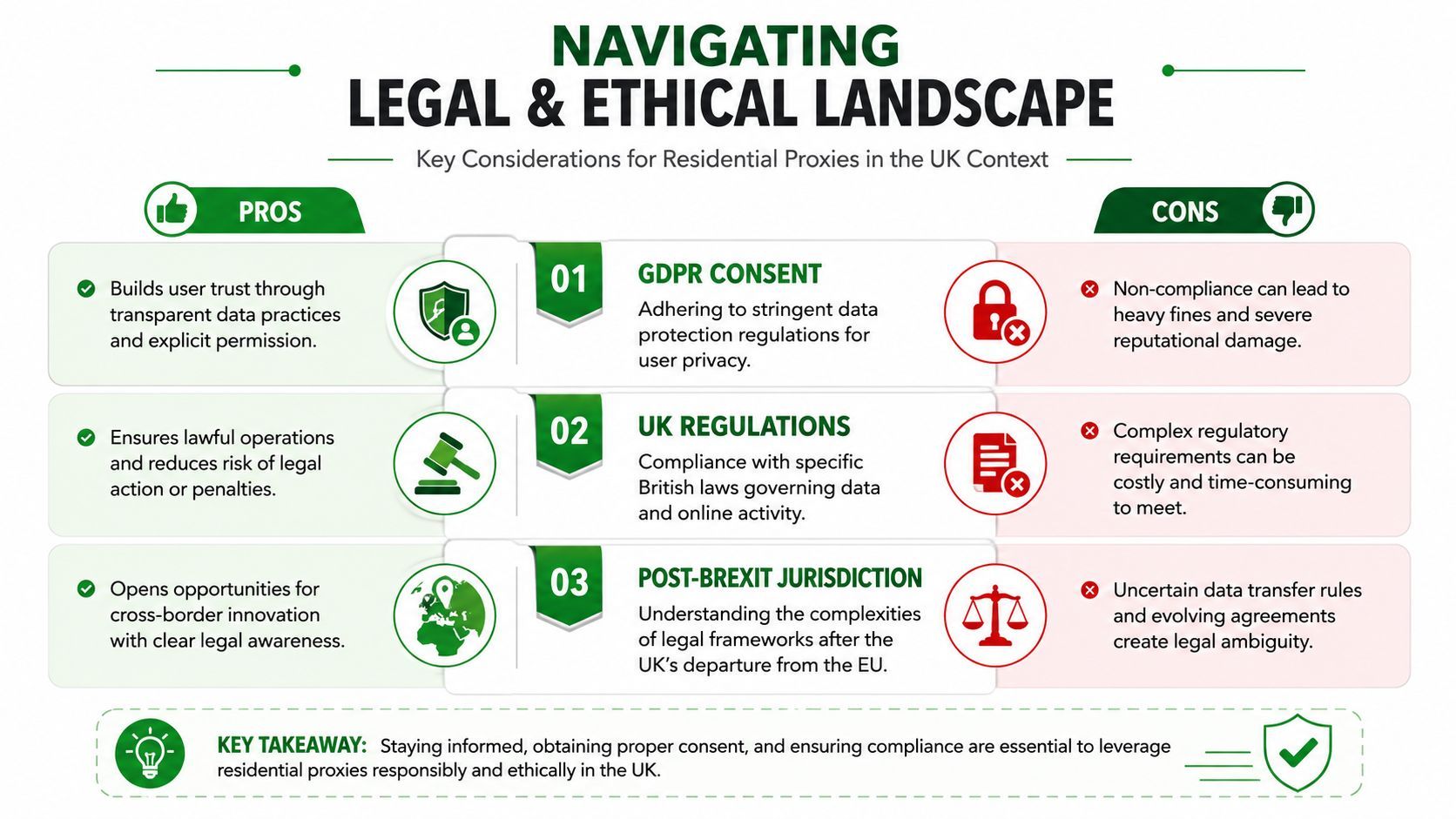
Residential proxy use isn't just a technical purchase. It's a policy choice, because the traffic inherits the reputation and jurisdictional context of real consumer connections. Independent guidance is blunt on this point, residential proxies carry a higher abuse reputation profile and shouldn't be treated as a default technical choice (SPUR residential proxy overview).
Consent and sourcing matter
If a provider is vague about how household connections are obtained, that's a problem. Teams should ask how consent is handled, how users are informed, and whether the pool is aligned with applicable privacy and data protection rules. The answer doesn't have to be legal advice in the sales call, but it should be specific enough that your security or compliance review can assess it.
UK segmentation is not the same as generic Europe
Several sources now emphasize city-level or postcode-level targeting across England, Scotland, Wales, and Northern Ireland, with post-Brexit segmentation making UK exits distinct from EU ones (UK proxy regional targeting guide). That matters because a generic European IP won't always produce the same commercial or localized output as a genuine UK session. For price intelligence, ad verification, and regional data capture, the jurisdictional difference is operational, not theoretical.
Best practice: treat residential sourcing like any other trust-sensitive supplier review. Ask for provenance, ask for consent handling, and document the business reason you need residential rather than a simpler proxy type.
The ethical standard is straightforward. Use residential traffic to access legitimate UK-localized content, testing, and monitoring, not to harvest data you wouldn't be comfortable defending internally. If the workflow touches personal data, legal review should happen before scale, not after the first block or complaint.
Selection and Evaluation Checklist
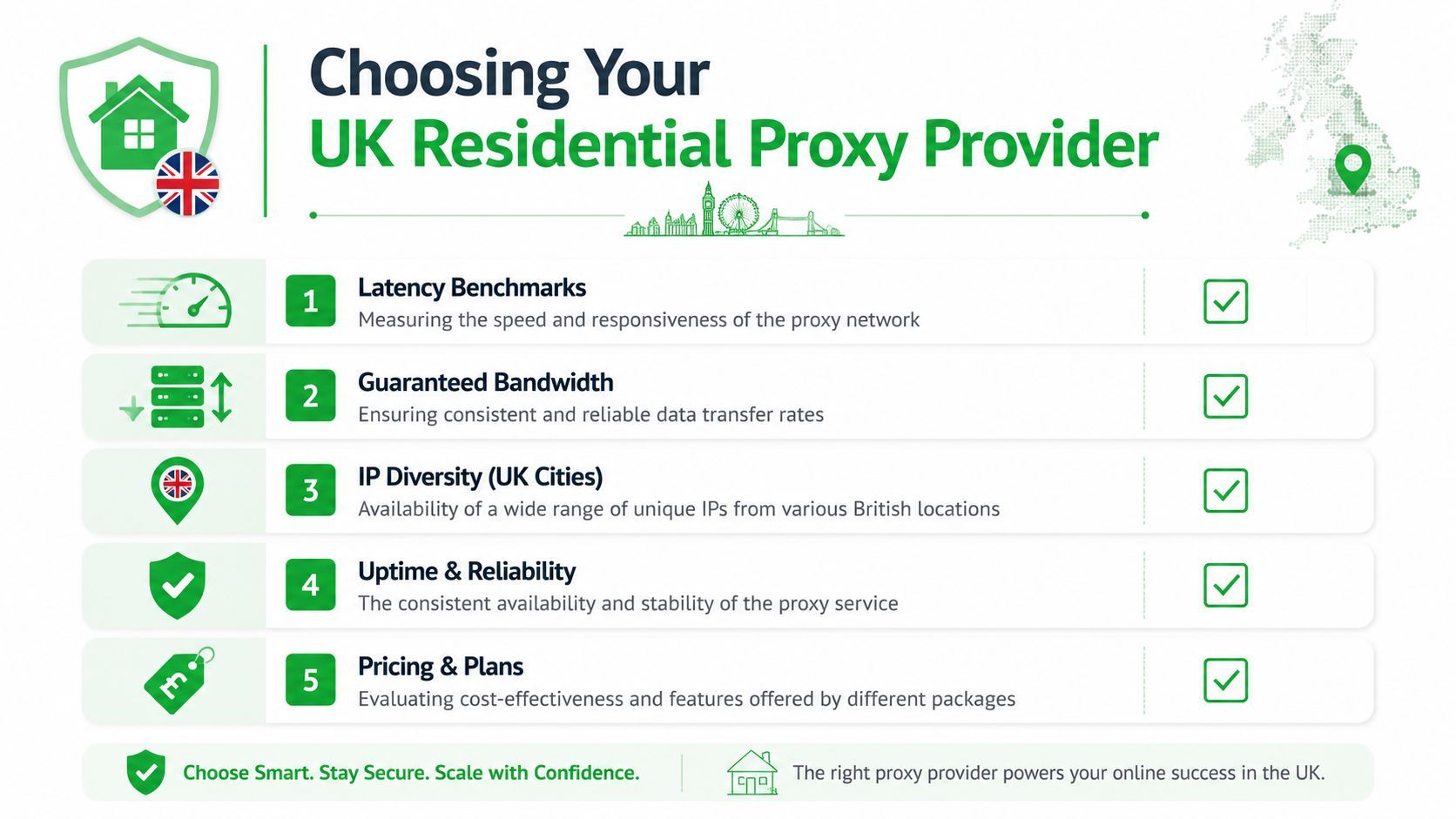
A good provider review starts with measurable criteria, not marketing copy. The first thing to check is whether the network gives you UK locality, then whether it keeps sessions stable long enough for your job type, and only then whether the pricing model fits the volume you expect.
What to verify before you buy
- Latency benchmarks. Test connect time and request time against your own target pages, not against a generic sample. The useful benchmark is whether the proxy stays inside your acceptable performance envelope when the target adds its own overhead.
- Guaranteed bandwidth. Confirm whether the service gives you predictable throughput or only best-effort access. If your queue model assumes stable consumption, vague bandwidth terms will create messy credit usage later.
- IP diversity across UK cities. Check whether the pool can reach the specific locations you need. Country-level access is a start, but city or postcode granularity matters when the target localizes by area.
- Uptime and reliability. Ask for operational transparency, incident handling, and whether the service behaves consistently under sustained load.
- Pricing and plans. Match the billing model to the workflow. Per-GB residential makes sense for controlled collection. Managed API pricing can make more sense when you'd rather outsource anti-bot handling.
For success-rate testing, don't trust a handful of samples. The practical guidance from the brief is to measure at least 385 requests per target class if you want an estimate within roughly ±5 percentage points at 95% confidence (coronium testing guidance). That's enough to reveal whether the pool is genuinely reliable on the pages that matter, instead of just looking good in a demo.
Several provider pages now advertise very large UK inventories, including 35,938 active UK residential IPs in one real-time pool and 1M+ active UK addresses in another (provider UK pool figures). Those numbers only matter if the pool stays usable in your own workflow, so treat them as a starting point, not a conclusion.
Integration Tips and Recommended Metrics
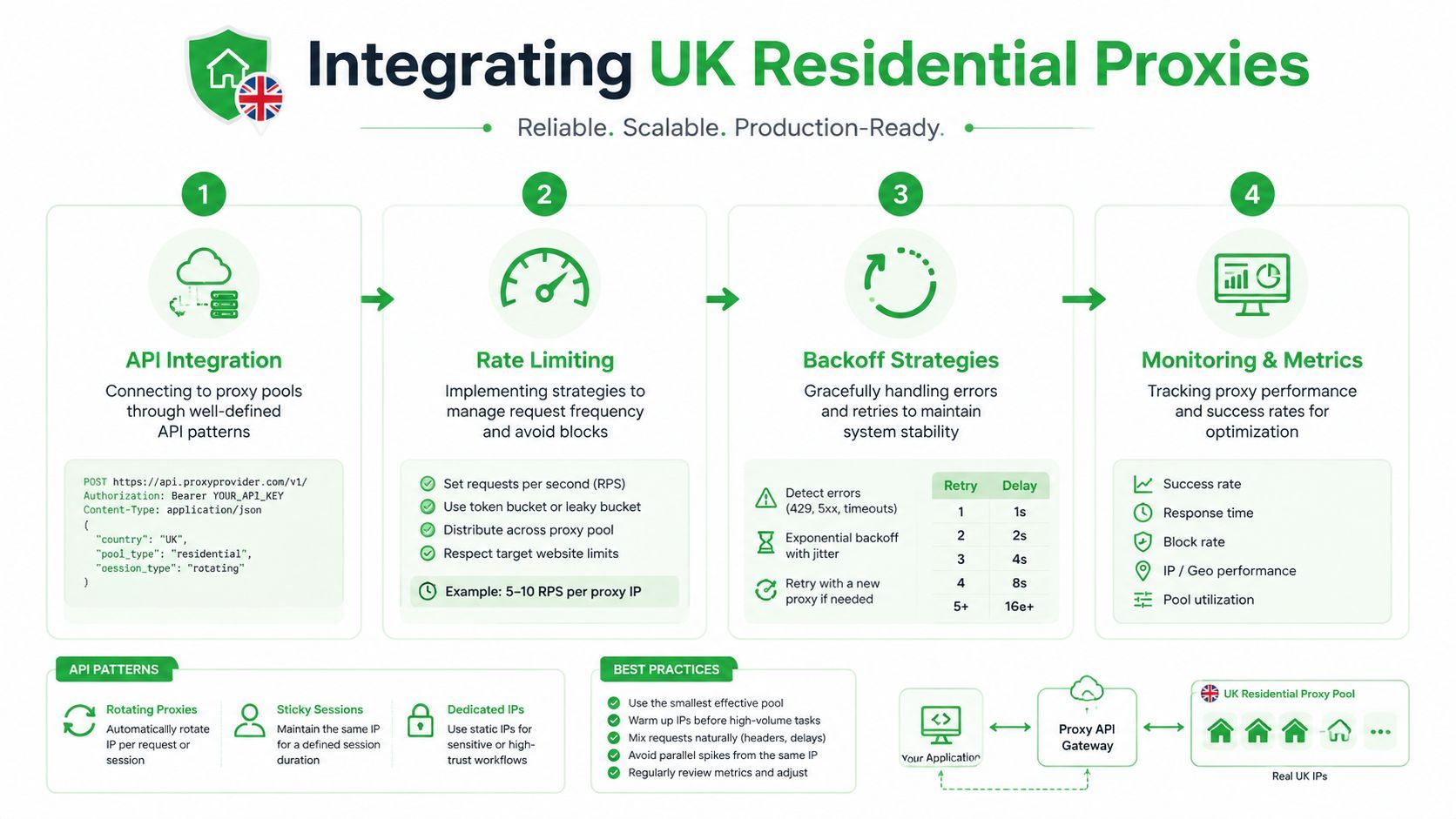
The cleanest integration pattern is boring. Wrap the proxy pool behind one service boundary, keep your retry logic explicit, and make the application decide when a failure is terminal versus when it should be retried with a different session. If you're feeding a YouTube download pipeline, that separation keeps the media job model stable even when the proxy layer is noisy.
Build for controlled rotation
Don't rotate every request by default. Let the job shape decide whether a session should stay sticky or move frequently, because many YouTube and UK-localized flows behave more predictably when the IP stays constant long enough to finish the interaction. Use backoff when the target starts rejecting requests, and avoid escalating quickly into aggressive retries.
Measure what actually matters
Track success rate per IP, average response time, and block event counts. Those three metrics tell you whether the pool is healthy, whether the target is slowing you down, and whether the failure mode is reputation, session design, or transient congestion. If your team only watches throughput, you'll miss the early signs that a proxy class is decaying.
The async job model should also stay visible to the caller. Submit the request, record the job ID, and poll until completion with clear states for retryable failures, blocked content, or terminal media unavailability. That keeps your application logic clean and makes it easier to separate provider issues from target-side limitations.
For implementation patterns, the API integration example is a good reference point because it shows how teams usually structure submission, polling, and error handling without letting proxy logic leak into the product layer.
Engineering habit that pays off: log proxy class, target class, and failure reason together. Without those three fields, you'll spend too much time guessing whether the problem was geography, reputation, or the target itself.
Conclusion and Next Steps
A UK residential proxy is worth the overhead when the target's output changes based on British locality, consumer-IP trust, or regional access rules. It's less about “looking UK” in the abstract and more about seeing the same page, metadata, and access path a real UK household would see. That distinction matters in YouTube workflows, especially when a download job depends on the right region, the right session behavior, and a provider that won't collapse under normal production load.
The trade-offs are consistent across the article. Residential gives you stronger legitimacy, but you pay with more variance. Mobile can be even more trusted on tough endpoints, but it's not the default answer. Datacenter is still useful, just not for every UK-localized workflow. The right choice depends on whether you need correct local output, stable session continuity, or a more affordable method to hit open pages.
The practical next step is to test on your own target set, not on a vendor demo. Build a small benchmark around the pages and jobs that matter, measure response time and block behavior, and compare the proxy class against the actual business result you need. Then lock the winning pattern into your queue, logging, and retry model so the integration stays maintainable after the first production spike.
If you're wiring UK-localized media ingestion into your product, YouTube Download API gives you a production-ready REST path for programmatic video and audio retrieval without making your team own proxy churn, cookies, or extractor maintenance. Pair that with the right UK proxy strategy and you get a cleaner route to reliable downloads, better localized access, and fewer operational surprises.