7 Best MCP Servers Worth Connecting in 2026
Explore the best MCP servers of 2026, compared by capabilities, integrations, setup, auth, and ideal use cases, plus tips for picking the right stack.
Dalvo · November 20, 2026
Which MCP servers deserve a slot in your client? Star counts and directory rank do not answer that. The Postman 2025 State of the API Report found that 70% of developers were aware of MCP, but only 10% used it regularly. Awareness is not a working setup. The gap is operational. Hosted versus local, how you authenticate, and how wide a tool can write decide whether Claude, Cursor, or VS Code should keep the process attached.
Registries now list hundreds of servers, and roundups like the DBotMaker automation tool rankings show how crowded generic connectors already are. This list stays with seven servers maintained by the platform or vendor behind them. For each one you get the setup friction, the auth model, the blast radius, and the job it does better than a raw API call pasted into chat.
Table of Contents
- 1. Vid Kraken
- 2. GitHub MCP Server
- 3. Microsoft Playwright MCP
- 4. Context7 MCP
- 5. Brave Search MCP Server
- 6. Sentry MCP Server
- 7. Stripe MCP Server
- Best MCP servers at a glance
- How to Choose and Connect Your First Three Servers
1. Vid Kraken
Say a clipping product needs a 45-second excerpt from a licensed YouTube upload, as MP3 for a dubbing pass and as MP4 for the editor. A local download binary means you own cookies, proxies, bot checks, and the next breakage when YouTube changes a request. Vid Kraken is the remote server I would connect instead of that pipeline. An agent submits a URL, polls an async job, and gets a direct HTTPS file link. The service handles bot detection, proxies, cookies, retries, and YouTube's frequent changes, so your product does not keep a download engine alive.
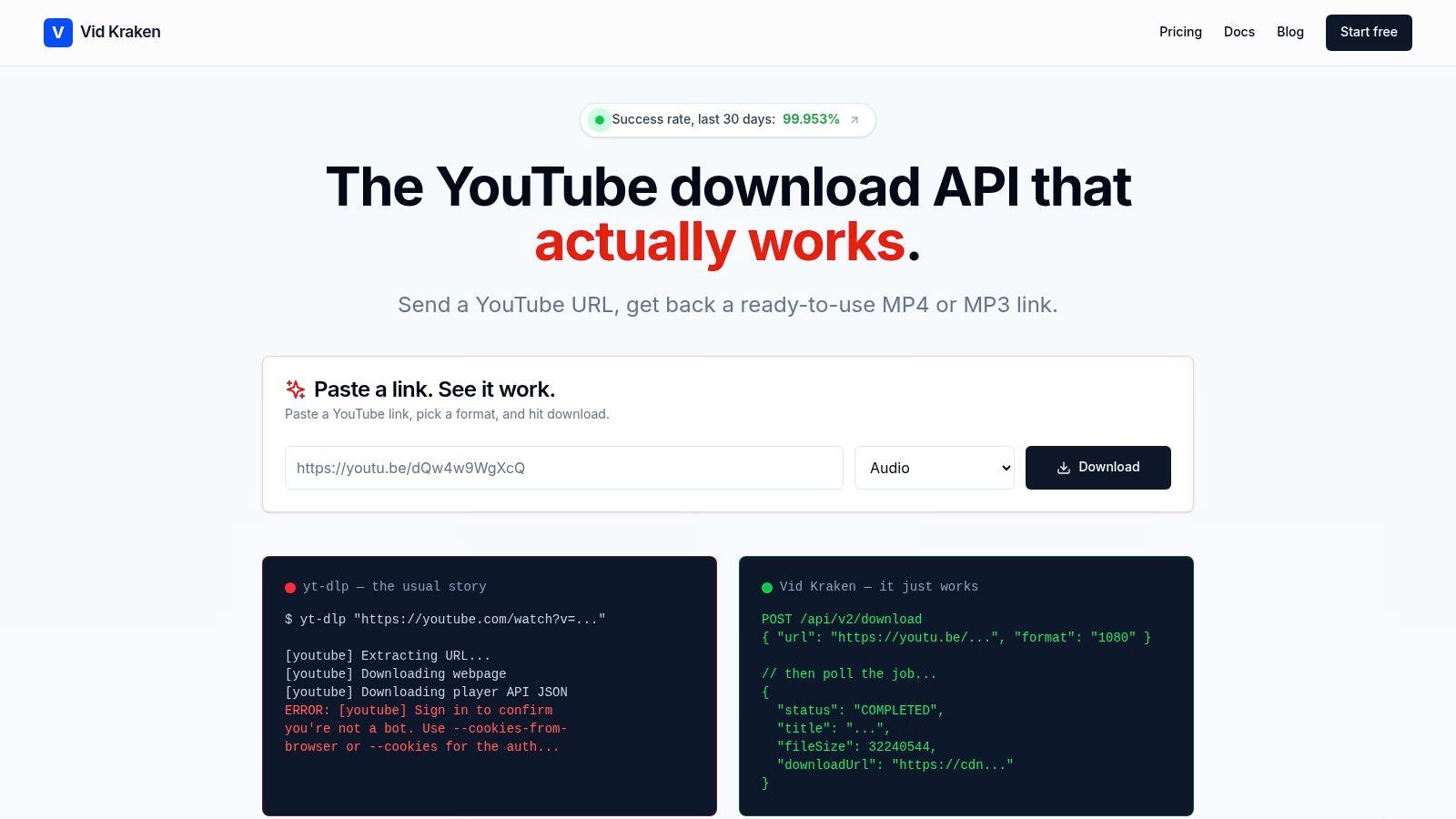
The server is hosted, listed in the official MCP Registry as com.vidkraken/vidkraken. Sign-in is OAuth 2.1 with PKCE: the user approves access with a Vid Kraken account, there is no API key to paste into a client config, and the grant can be revoked from the account. A second, read-only docs server lets an agent search the docs, guides, and pricing without signing in, which covers "how do I do X" questions before a user ever connects their account. Tool scope stays on download jobs, metadata, clip status, and account usage. That is a narrower blast radius than a shell that can fetch anything the process can reach. Private, age-restricted, members-only, geographically restricted, and DRM-protected videos return machine-readable error codes, and those restrictions are not presented as bypassable.
What the agent can request
- Video: MP4 from 360p to 1080p on standard plans, H.264 by default, with 4K on request.
- Audio: a real 320 kbps MP3, YouTube's AAC stream in an M4A container, or the original stream with no re-encode. A BCP-47 language tag prefers a dubbed track, then falls back to a track whose tag starts with that value, then to the original audio.
- Clips: start and end times trim the requested segment, with title and duration returned at submission. Completed jobs return a direct HTTPS URL and file size.
- Billing: bandwidth rather than download count. Monthly plans start at $99, a pay-as-you-go option starts with a one-time $49 payment, and custom committed-bandwidth agreements go as low as $0.06 per GB. Each download has a 20 MB minimum billable size. Failed jobs, metadata lookups, polling, auth failures (401), and limit errors (403, 429) are not charged.
MCP calls bill against the same plan balances as the REST API: clips consume the download and bandwidth allowance, video lookups consume the info allowance, and there is no separate MCP metering to reconcile. SaaS companies already run the service in production, and the live reliability page reports 99.995% of downloads completed over the last 30 days, counted per video. One founder of a media automation tool described the trade-off plainly. "The reliability was fantastic for the price."
Practical rule: If the only win is "the agent can call YouTube," you still own the failure domain. A managed job with free failures and a revokeable OAuth grant is the smaller operational bet.
Directory fame is a weak proxy for that bet. An ecosystem paper on MCP operations notes that listings are not growing uniformly. MCP.so has largely plateaued while MCP Market accounts for most ongoing growth. Pick the server whose error semantics you can code against. Setup for Claude and other clients is in the Vid Kraken MCP server docs. The cost sting is real on tiny files because of the 20 MB floor, and 4K is on request rather than on every plan. Channel listing and client download are account add-ons you enable by contacting Vid Kraken, and their balances appear only on accounts where the add-on is active. Polling and account lookup stay free.
2. GitHub MCP Server
GitHub's server is the one engineering agents reach for when the task is the repo, not the web. Issues, pull requests, file context, and workflow actions show up as tools instead of a browser tab the model half-reads. You can run the hosted remote server or a local process. Hosted is the lower-friction default. You are not babysitting a Node process on every laptop.
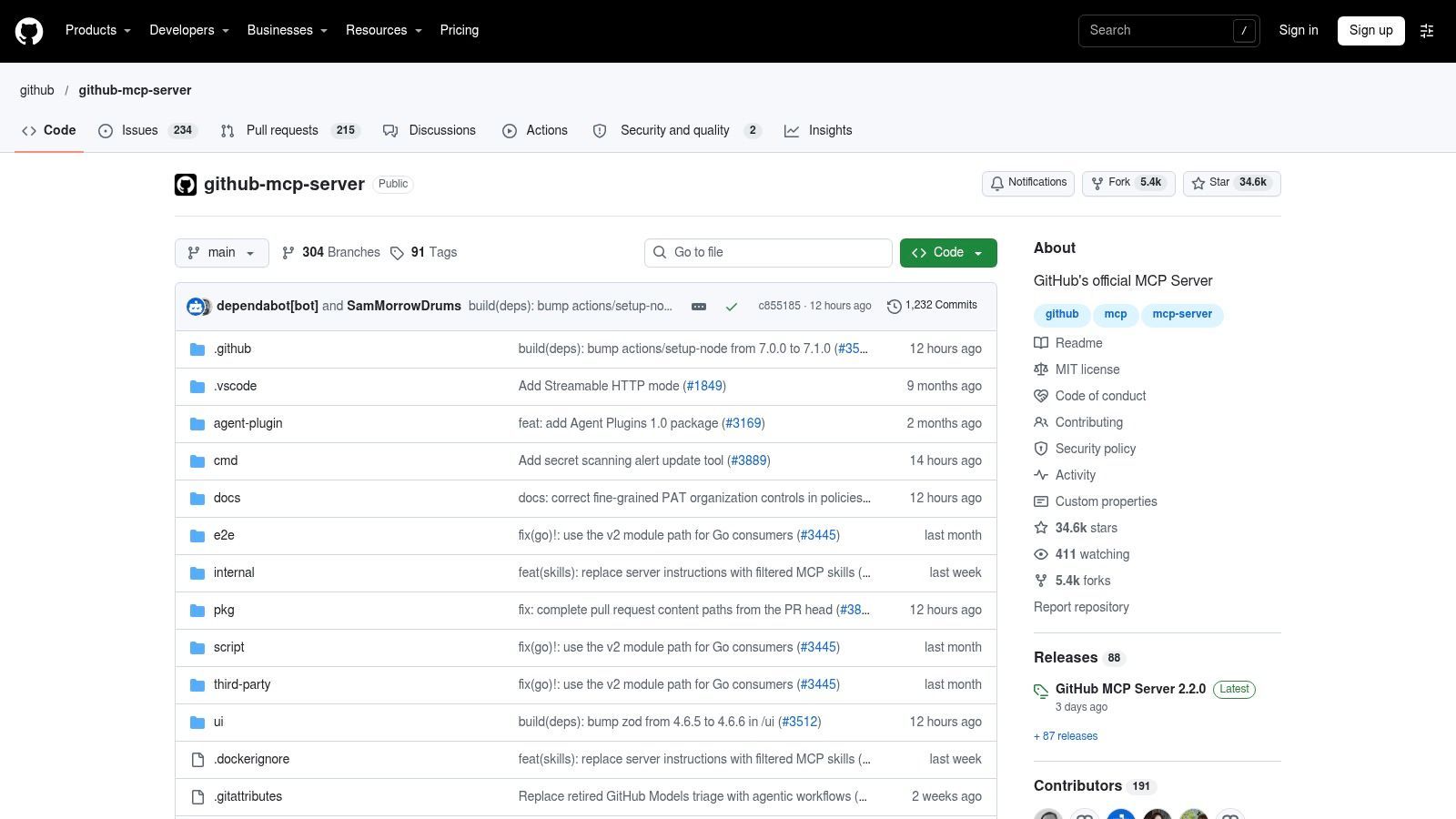
Auth is OAuth or a personal access token, depending on the setup. OAuth wins for a team because you can revoke the grant without rotating a token that someone committed into an MCP config. Toolsets are configurable, which is the control that matters. A triage bot does not need admin mutation on every repo the token can see.
Anthropic's MCP launch on November 25, 2024 already shipped GitHub among the first integrations, next to Google Drive, Slack, Git, PostgreSQL, and Puppeteer. That history is why client support is broad. It is also why people enable every toolset on day one. That is the failure mode. A read-heavy review agent and a write-capable release agent should not share one wide configuration.
The MCP overview for agents is a useful contrast. Protocol access is not the same thing as a safe scope. GitHub maintains this server, and GitHub users can connect it regardless of plan, though some underlying product features still sit behind paid tiers. You still need a compatible client and permissions that match the tool. If a tool 404s, check the feature and the token before you blame the protocol.
A PAT in a shared dotfile is a standing credential. Prefer the hosted OAuth path, then delete toolsets until the agent can still do the one job you hired it for.
Use it to draft a PR summary from the diff, or to file an issue with reproduction steps already in the repo. Do not use it as a general shell into your org.
3. Microsoft Playwright MCP
Browser work is where search snippets lie. You need the live page, the accessibility tree, and a click that either lands or fails in a way you can read. Playwright MCP gives the client that surface. Structured page and accessibility data, headed or headless runs, and either a persistent profile or a clean isolated one. It speaks to VS Code, Cursor, Windsurf, and Claude Desktop, over local stdio or HTTP.
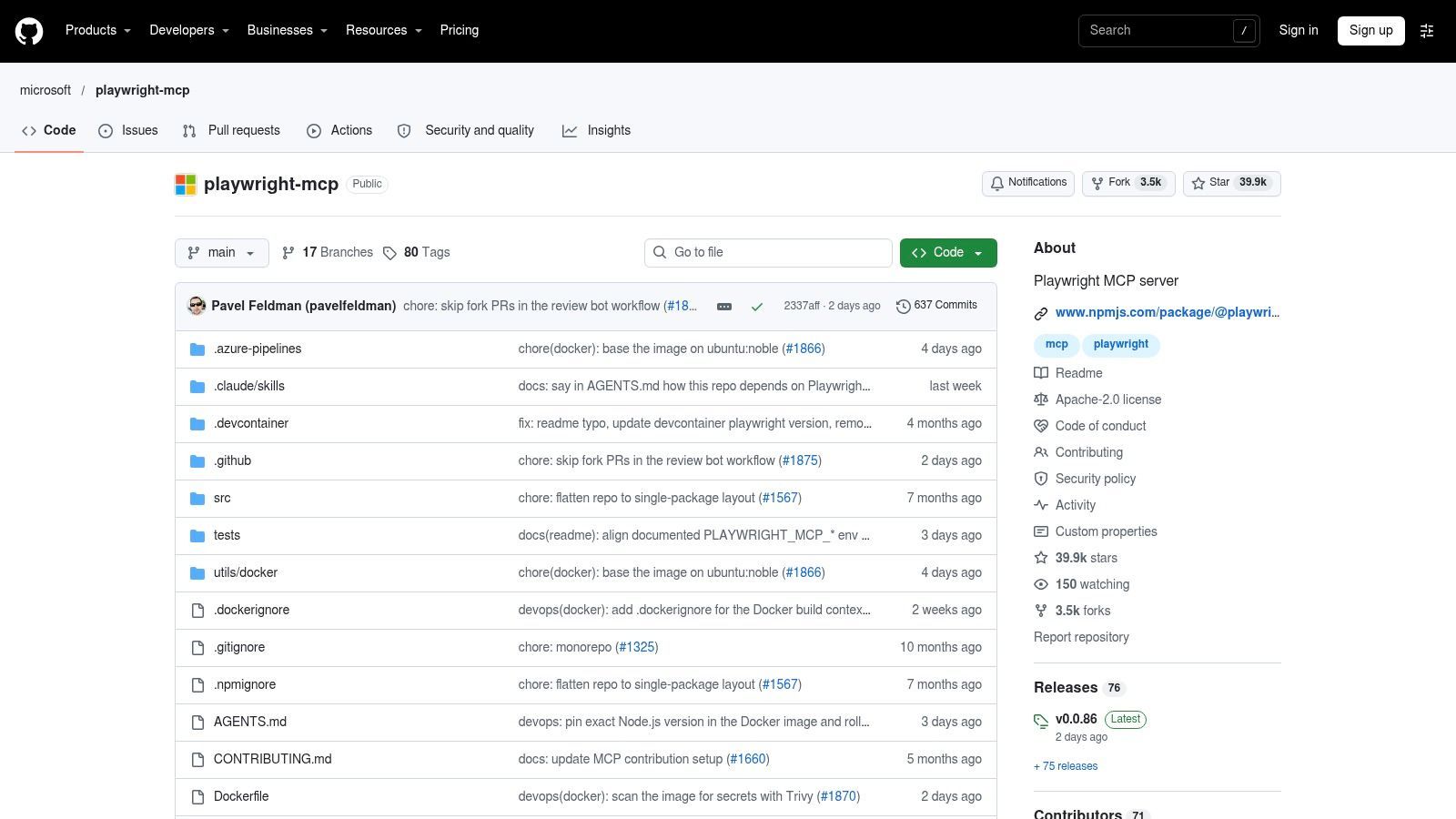
Setup friction is concrete. The documented path wants Node.js 20 or newer. Persistent profiles are one browser instance at a time. Parallel sessions need separate profiles or isolated mode. Forget that and the second agent sits on a locked profile while the first holds your logged-in state.
Microsoft backs it through the Playwright project, so the browser layer is the same one UI tests already use. The server itself is not a security boundary. A headed profile with saved cookies can act as whoever last logged in. Treat the machine, the profile directory, and the network egress as the boundary. Local stdio keeps that blast radius on the developer workstation. An HTTP deployment needs the same care you would give any service that can browse internal tools.
Protocol speed is rarely the cliff. Independent testing of 15 MCP implementations ran 39.9 million requests against real Redis and HTTP I/O and reported a 0% error rate, with the fastest group in a 4–7 ms average-latency band under I/O-bound load. Once Playwright is driving a page, navigation and rendering dominate those milliseconds. Bound the tool list, reuse the browser, and do not let the agent open a fresh context for every sentence.
A solid use case is a QA pass on a staging signup form. The agent reads accessible names, fills fields, and reports the failure from the page, not from a hallucinated selector. It is a poor fit as an unattended crawler against sites you do not operate.
4. Context7 MCP
Coding agents guess library APIs from training data, then you spend the afternoon deleting methods that never shipped. Context7 searches a library and pulls documentation into the client so the answer tracks the docs that exist now, not a two-year-old snapshot.
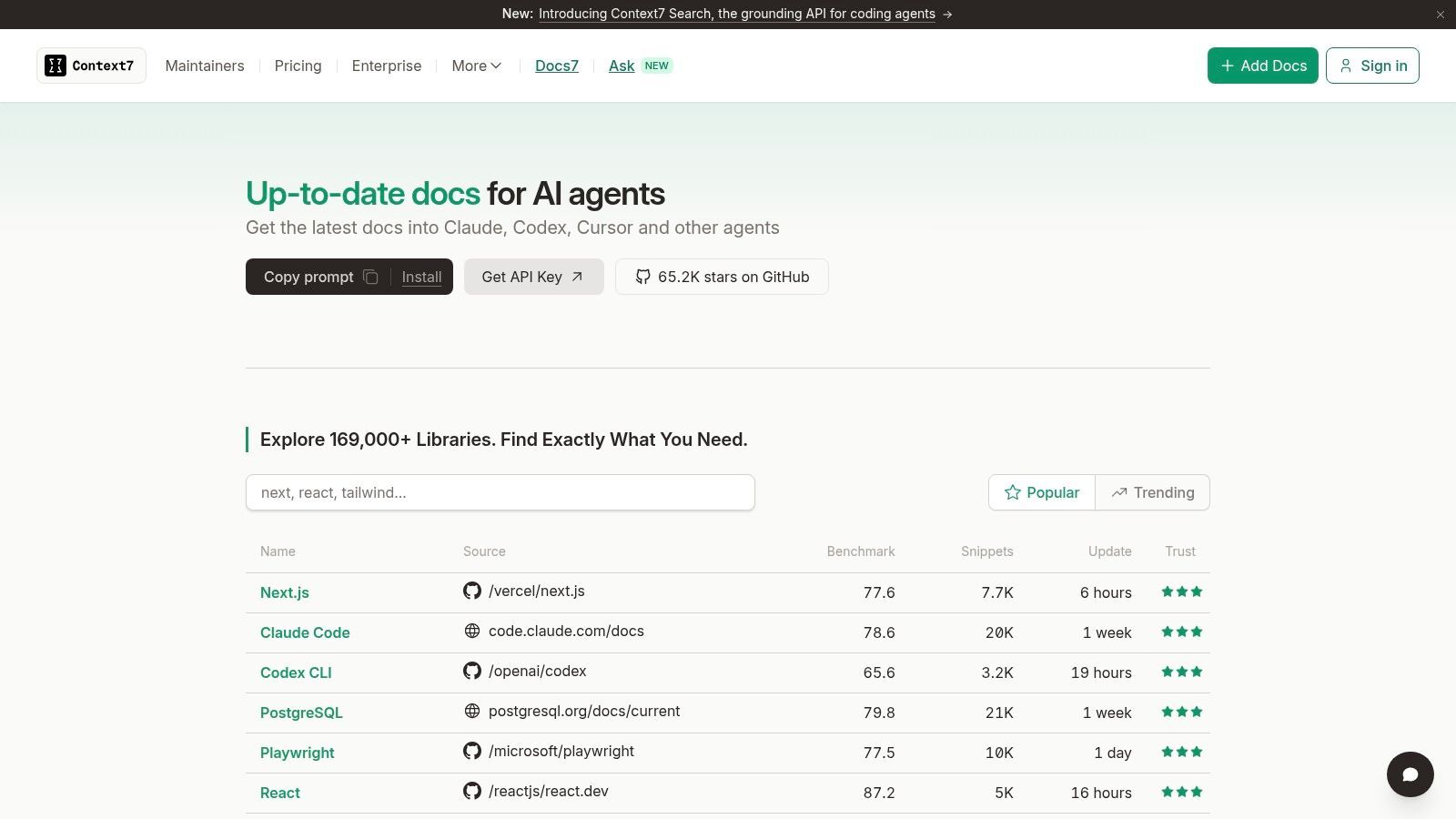
You can attach the hosted endpoint or run the local package with npx. Hosted avoids a process you have to restart when the client updates. Local is the path when traffic must stay on the machine. Auth is OAuth or an API key, depending on which connection you pick. The local troubleshooting notes want Node.js 20.18.1 or later. If npx fails on an older runtime, that version pin is the first thing to check, not the prompt.
Maintenance is the definitive selection test for a docs server. A 2025 measurement of 8,401 valid MCP projects found that only 40.9% of servers had been updated within the preceding 90 days, while 21.9% had been inactive for more than a year. A documentation connector that goes quiet will keep serving stale shapes with a confident tone. Context7's hosted endpoint and multi-client setup notes are why it stays on this list. Results still depend on whether that library's docs are in the index.
Where the preview features stop
Optional research-preview tools cover code search and upgrade guidance. Treat them as previews. They can help a migration sketch, and they can also be less stable than the core library lookup. I would enable the docs tools first and leave previews off until a task needs them.
Pair it with the way you already choose tools for an AI agent. Context7 does not replace reading a changelog before you merge. It stops the agent from inventing an import that the current major never exported. If the library is obscure or the docs are thin, you will get a thin answer. That is a property of the corpus, not a bug in the client.
5. Brave Search MCP Server
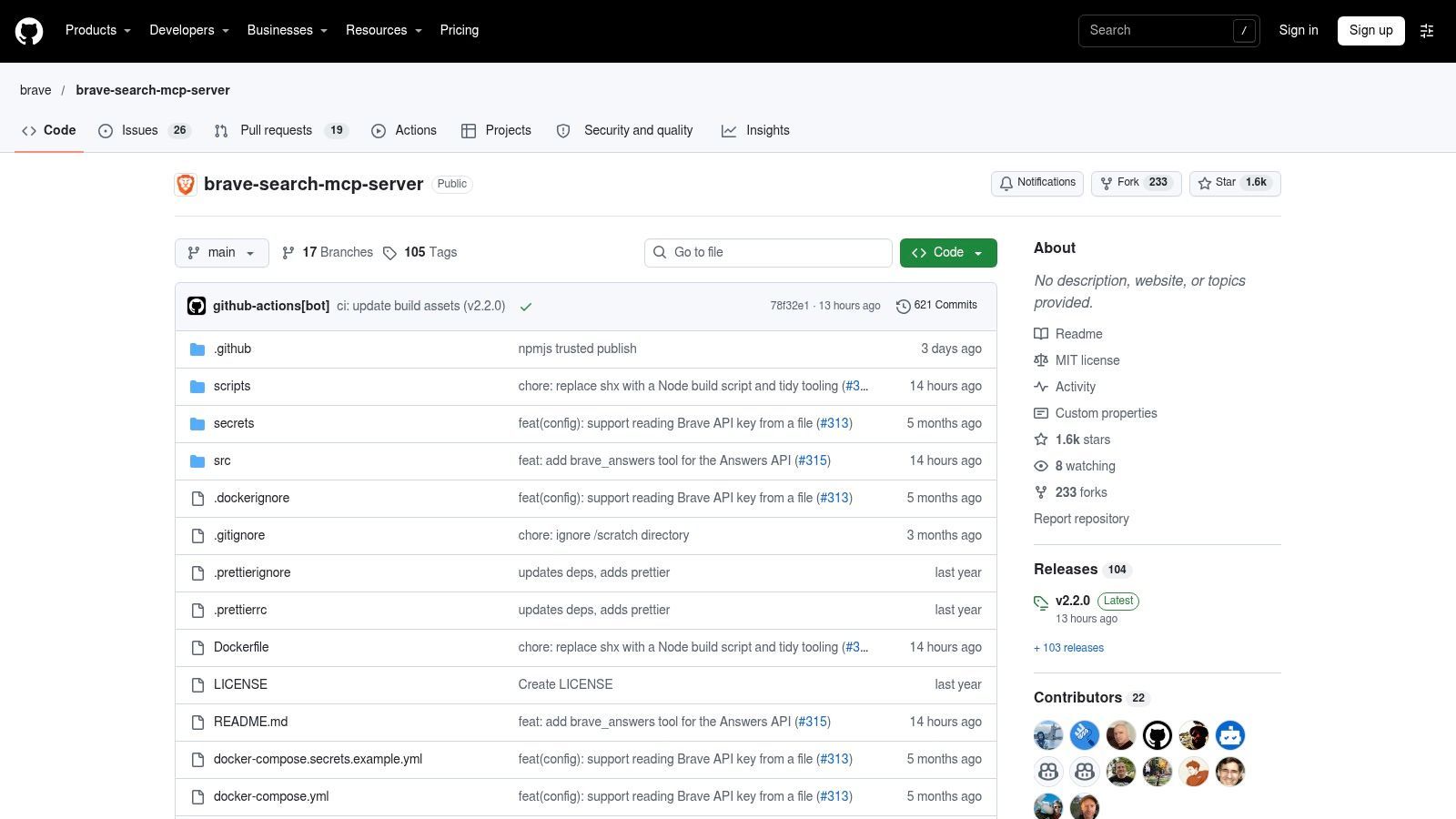
When the agent needs the public web, a vendor-maintained search server beats a scraped browser for most research steps. Brave's official server fronts the Brave Search API with web, news, image, video, local, and place search, plus summarization and model-oriented context tools. You can turn tools on or off, which is how you keep a research agent from wandering into local-business lookups it does not need.
Transport is local stdio or HTTP. For a laptop or single-client setup, run stdio with the API key stored in the environment; nothing listens on a port and the key never leaves the machine. The catch is on the HTTP side. The default HTTP endpoint does not authenticate callers. If you bind that listener beyond localhost, anyone who can reach the port spends your quota. Put it behind your own auth, or do not expose it.
A 2025 Zuplo survey found that 58% of MCP builders were wrapping existing APIs, while 23% were creating new APIs specifically for MCP. Brave sits in the majority pattern, and that is a feature. You already understand API-key plans, rate limits, and what a 429 means. The server does not invent a second billing universe. It does require a Brave Search API key, and usage follows that plan's caps. A client that retries blindly will burn the allowance faster than a human searcher.
The blast radius here is spend, not data. The tools read public results, so the worst case is a drained quota rather than a leaked record. Use it to ground a design note in current docs and recent news, with the tool list cut down to web and news. Do not treat summarization output as a citation. Open the result URLs you care about. For pages behind a login, this server will not help. That job belongs to a browser tool with a profile you control, not to a wider search key.
6. Sentry MCP Server
Production errors should not be copied into a chat box by hand. Sentry's server lets the assistant search issues, traces, and performance data, then help with triage, in the project where the event lives. There is a hosted remote endpoint with OAuth, plus a local stdio package that can talk to self-hosted Sentry. Hosted OAuth is the right default on sentry.io. Local stdio is how you keep an air-gapped or self-hosted org off a vendor relay.
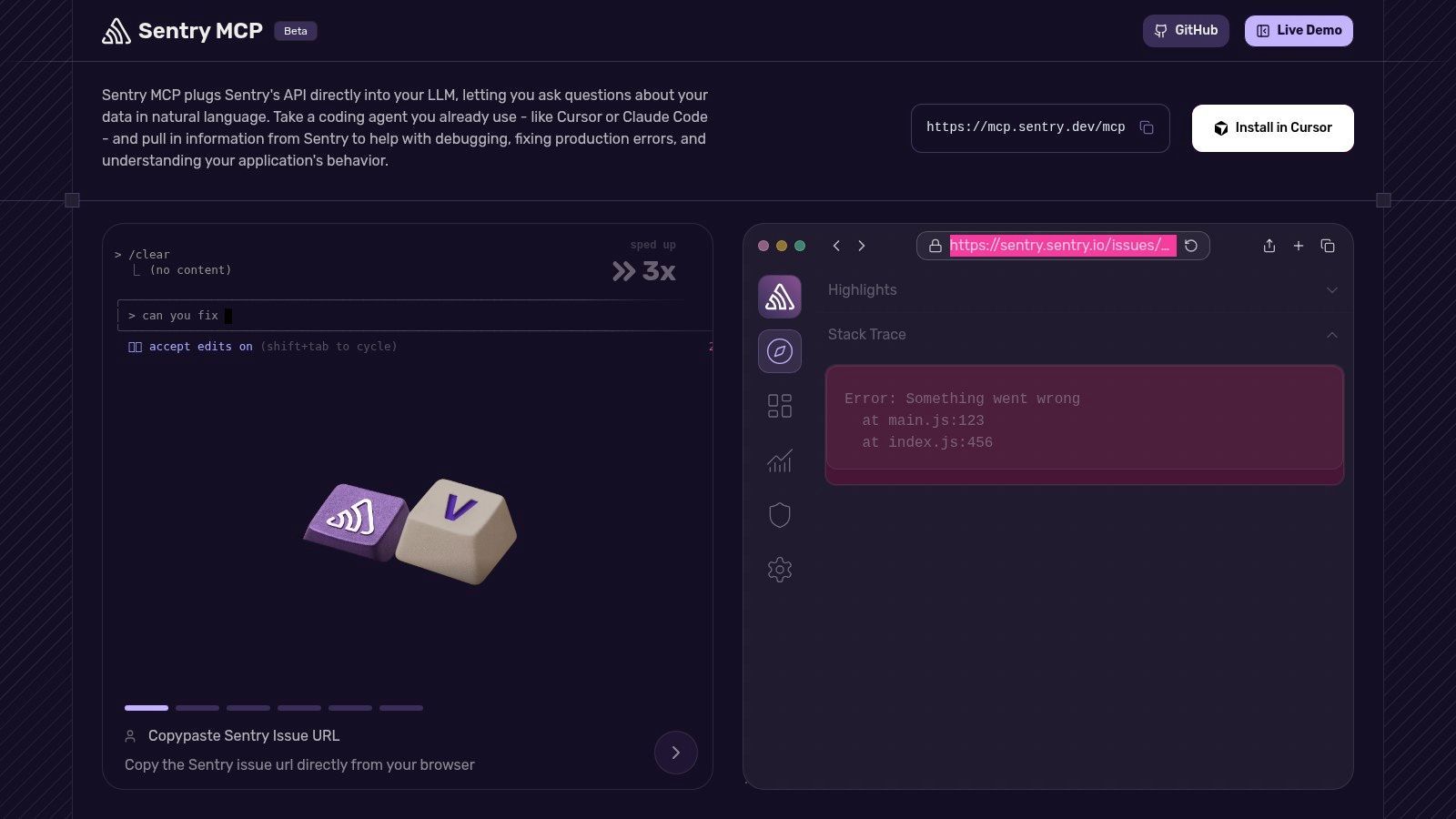
Scope it. Organization and project limits cut the tool surface so an agent helping one service cannot wander the rest of the org chart. You still need a Sentry account and permissions that match the questions. Some AI-powered search tools on the local server want a separate LLM-provider configuration. Budget that setup before you promise the team a natural-language issue search.
Catalog size is not a quality signal for this category either. During a 14-day collection, MCPCrawler gathered 17,630 raw directory entries and identified 8,401 valid projects, 8,060 servers and 341 clients. A first-party Sentry endpoint is easier to defend in review than a random "error helper" from that long tail.
The workflow that pays off is a Sev-2. The agent pulls the stack, nearby releases, and trace context, then drafts the suspect commit list while you still have the incident channel open. It is specialized. If you do not run Sentry, this server adds nothing but another OAuth consent screen. Keep write-ish project actions for people who already hold those roles in Sentry, and start the agent on read tools.
7. Stripe MCP Server
Stripe's server is the sharpest blast radius on this list, and that is why it belongs here rather than in a novelty drawer. The hosted endpoint at mcp.stripe.com connects coding clients such as Cursor, VS Code, Claude Code, and ChatGPT to Stripe API workflows and documentation. Some tools are not read-only. They can touch financial objects, including charges and refunds, once you have authorized the account.
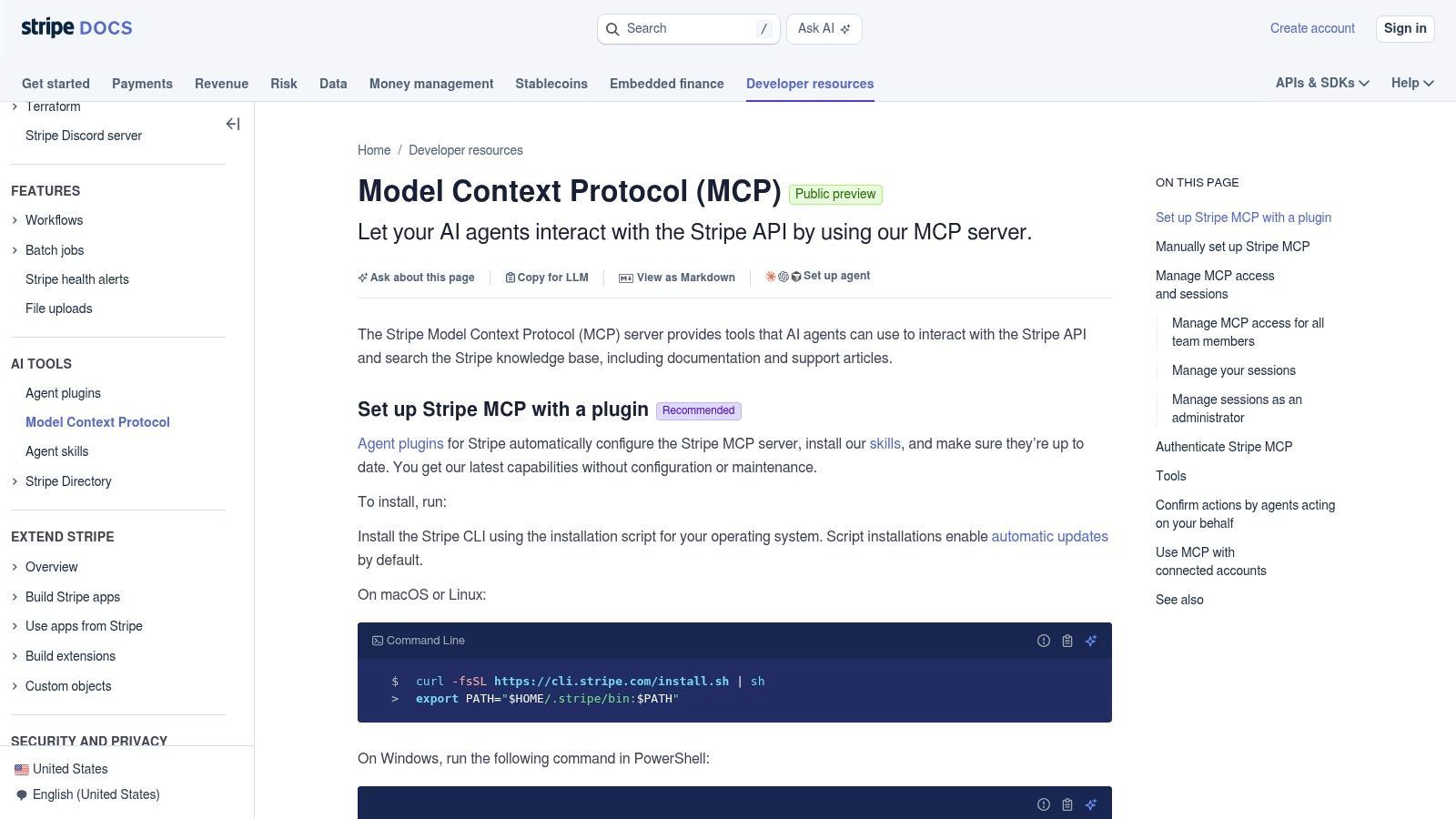
That combination is the point and the risk. Docs lookup stops the agent from inventing a PaymentIntent parameter. Live object access stops you from pasting dashboard JSON into the prompt. Write access means a sloppy tool description can move money. A 2025 study of 1,899 open-source MCP servers found that 7.2% contained at least one general security vulnerability, credential exposure was the most common issue at 3.6%, and 5.5% showed MCP-specific tool-poisoning problems. Stripe maintains this server, which removes the abandoned-repo problem. It does not remove the need to read which tools are enabled.
- Start read-only: documentation and retrieval while you build the integration.
- Separate the write grant: refunds and charge actions only for a client config you do not share with general coding chats.
- Skip it if the product does not use Stripe. An idle financial server is not a neutral extra.
I would rather have a hosted Stripe server with a tight tool list than a local script holding a secret key with broader API rights. You still need a Stripe account and an explicit authorization step. Revoke that grant when the experiment ends.
Best MCP servers at a glance
Each row answers the questions that decide adoption: where the server runs, what credential it asks for, and what setup stands between install and a working tool call.
| Server | Best for | Hosting model | Authentication | Setup complexity |
|---|---|---|---|---|
| Vid Kraken | Managed YouTube downloads for apps and automated workflows | Managed cloud API and remote MCP server | OAuth 2.1 with PKCE | Low; integrate via API or MCP |
| GitHub MCP Server | AI-assisted GitHub repository and development workflows | Hosted remote or local | OAuth or personal access token | Moderate; requires MCP client and permissions |
| Microsoft Playwright MCP | AI-driven browser automation and UI testing | Local or HTTP server | No credential for a local run | Moderate; requires Node.js 20 or newer |
| Context7 MCP | Providing library documentation to coding agents | Hosted endpoint or local package | OAuth or API key, depending on setup | Low to moderate |
| Brave Search MCP Server | Web and specialized search for AI clients | Local stdio or HTTP server | Brave Search API key | Moderate; requires API key and configuration |
| Sentry MCP Server | AI-assisted Sentry issue and performance investigation | Hosted remote or local stdio | OAuth for hosted server; Sentry account and permissions for local | Moderate |
| Stripe MCP Server | AI-assisted Stripe documentation and payment workflows | Hosted endpoint | Stripe account and explicit authorization | Low to moderate |
Read the authentication column first. It tells you where the credential lives and what the blast radius looks like if a tool call goes wrong.
How to Choose and Connect Your First Three Servers
The strongest MCP setup is rarely the biggest one. Pick one server per job: code, browser, search, or a data system. Connect them one at a time, and test each toolset in a scoped configuration before you widen access. A client stuffed with overlapping search tools and three docs servers will spend its context window choosing, not answering.
Prefer hosted, OAuth-based endpoints when the vendor offers them. Tokens disappear from dotfiles, and you revoke access in one admin screen instead of hunting laptops. Local stdio still wins for a browser profile, a self-hosted Sentry, or any tool that should never see a public listener. If the HTTP transport does not authenticate callers, do not put it on a shared network and call it done.
Compare the server with the underlying API before you commit. You save the glue that turns REST into tools the model can call. You add an adapter that can lag, a second place where credentials live, and a failure mode when the upstream product changes. Keep an exit path: if the server stalls, your app should still be able to call the API directly.
As a concrete first connection for media pipelines, the Vid Kraken MCP server is listed in the official MCP Registry as com.vidkraken/vidkraken. It lets Claude and other AI agents use Vid Kraken directly, with OAuth 2.1 and PKCE handling sign-in so there is no API key to paste, and MCP usage bills to the same plan balances as direct API calls. A second read-only server exposes the docs, guides and pricing to agents without any sign-in, which is a low-risk way to test the toolset before granting account access. Pair it with one code server and one search or browser server, not with five lookalikes.
How an agent reaches a page is a different slot from how it fetches a file, and the write-up on how MCP connects agents to browsers is the right companion if Playwright is your second install. Wire up two or three servers this week, note which tools the agent calls, and prune the rest. Your context window and your security review both get easier when the unused grants are gone.
If your agent pipeline needs licensed YouTube video or audio without a homegrown cookie and proxy stack, we expose that job as a remote MCP server with OAuth and the same bandwidth billing as the API. It is the practical answer when one of your best MCP servers has to return a real file, not another search snippet. See what the tools cover and connect a client at Vid Kraken.