10 Data Collection Firms for Modern Data Workflows
Compare 10 data collection firms for web data, media ingestion, AI training, pricing models, integrations, and vendor selection.
Dalvo · August 20, 2026
A sourcing decision can look simple until the workflow is written down. Your team may need lawful YouTube media retrieval, rendered pages from JavaScript-heavy sites, structured news feeds, business records for enrichment, entity-level web knowledge, or retail pricing intelligence. Those needs may all sound like “data collection,” but they create different requirements for coverage, extraction method, delivery format, and operational ownership.
This directory compares data collection firms and platforms by workflow, not by a generic feature checklist. For each provider, assess the source types it handles, whether it delivers infrastructure or a finished data product, how it charges, how much integration work remains with your team, and where quality, legal, security, or maintenance risks sit. The practical questions are straightforward: can it deliver through an API or files, does it support batch or near-real-time access, what does an SLA cover, and how will you verify the output?
The distinction matters because the market spans three models. Infrastructure providers supply proxies, browsers, crawlers, and extraction APIs. Managed data products deliver normalized records or vertical intelligence. Specialized media services solve a narrower ingestion problem, often with less engineering work. Start with the data workflow, then test the vendor against the contract your system needs.
Table of Contents
- 1. YouTube Download API
- 2. Bright Data
- 3. Zyte
- 4. Oxylabs
- 5. Apify
- 6. Webz.io
- 7. Coresignal
- 8. Diffbot
- 9. DataWeave
- 10. Dataprovider.com
- Top 10 Data Collection Firms Comparison
- Turn the Shortlist Into a Testable Data Contract
1. YouTube Download API
A media ingestion pipeline fails differently from a web crawler. An application may accept a YouTube URL, return metadata quickly, prepare an audio or video asset asynchronously, and pass a direct file URL to transcription, clipping, analysis, or redistribution. A general proxy platform can supply useful infrastructure, but the application may still own extractor behavior, browser sessions, retries, and error handling.
YouTube Download API, branded on its site as Vid Kraken, targets this narrower workflow. Its REST model accepts a URL and format, processes the job, and returns file details with a direct CDN download URL. Metadata such as title, duration, and file size can arrive before the asset, allowing a product interface to display useful information while processing continues.
Where it fits
The service supports MP4 video from 1080p to 144p and MP3 audio, with multi-language audio selection and fallback behavior for dubbed videos. Timestamp trimming and clipping can reduce unnecessary downloads when an application needs only a segment. The resulting output is a media-ingestion primitive, not a conventional web-data record.
The provider centrally manages bot detection, cookies, proxy rotation, extractor updates, and transient retries. The site reports 99.91% reliability over the last 30 days and says the service is used by 70+ SaaS teams. Both claims require validation against the buyer's own sources, formats, and traffic patterns during a pilot. Direct CDN links remove an extra redirect layer, while queue-based processing separates request handling from asset delivery.
The API integration example documents that asynchronous design. Implementation work should focus on storing job state, defining retry limits, and classifying terminal errors rather than treating media requests as synchronous transactions.
Legal boundary: Customers remain responsible for having the right to download and use the content. Private, members-only, DRM-protected, age-restricted, geo-restricted, or unavailable videos return machine-readable errors rather than being treated as successful downloads.
Cost and limitations
Pricing is credit-based. Public tiers include Starter at $99 per month for 1,000 downloads and 400 GB, Growth at $399 per month for 8,000 downloads and 2 TB, and Scale at $1,499 per month for 60,000 downloads and 10 TB. Overages are charged by download and gigabyte, while enterprise arrangements use negotiated volume rates. These figures are listed by the provider, so a cost model should track both request volume and media size.
The main tradeoff is scope. The service currently tops out at 1080p MP4 and MP3, meaning 4K or alternative container requirements may require another provider or an additional processing layer. It also does not bypass access controls. For a SaaS import feature, video AI pipeline, captioning service, or long-form-to-short workflow with lawful access rights, its value lies in reducing maintenance between a submitted URL and a usable media asset.
2. Bright Data
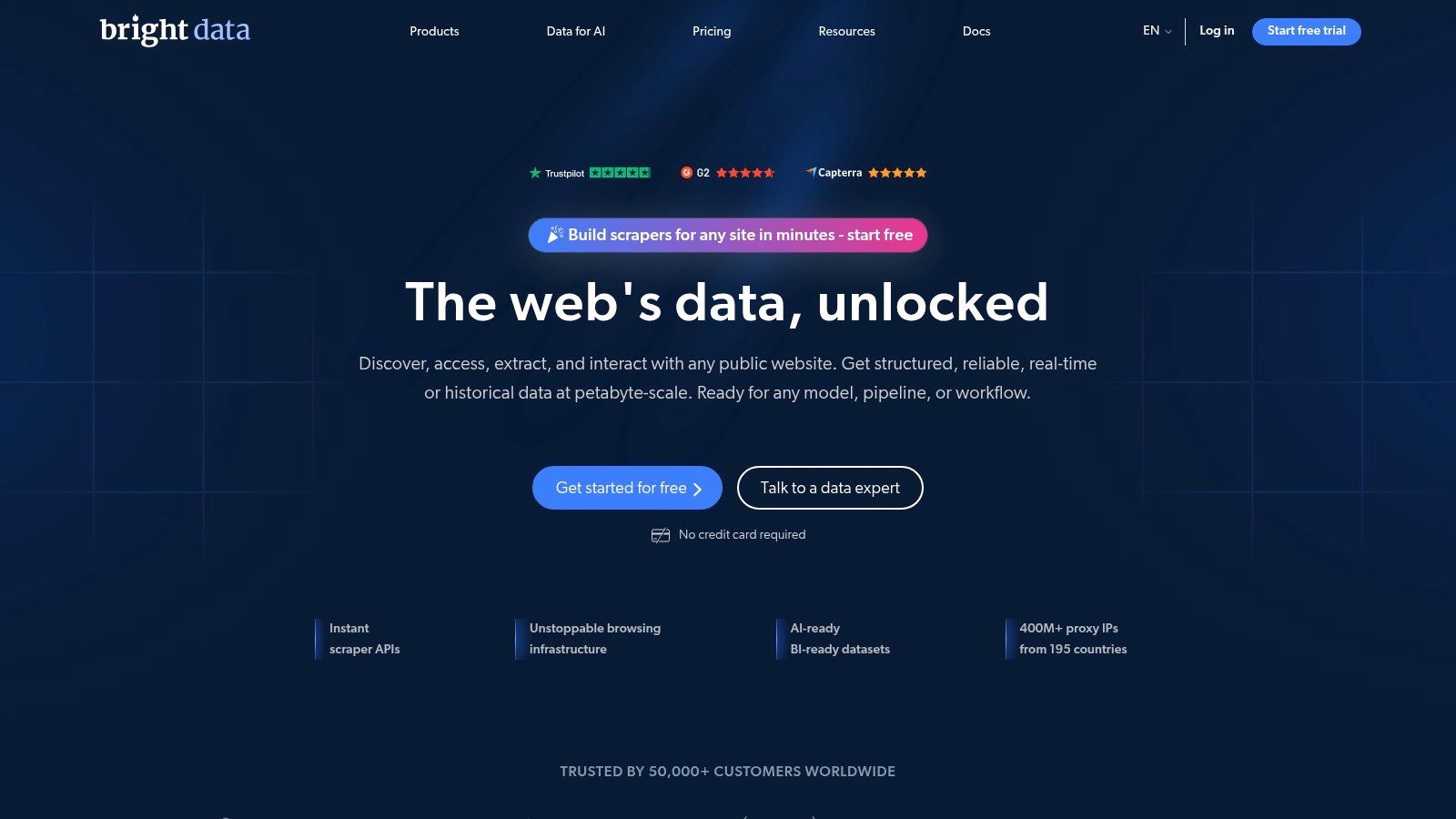
Bright Data is a broad web-data infrastructure provider for teams that need to collect information across public sites rather than retrieve one defined media type. Its Web Scraper API can return structured JSON or CSV, while browser and specialized proxy capabilities address targets that require JavaScript execution or more advanced anti-bot handling. That makes it a candidate for portfolios containing product pages, listings, search results, and other changing web interfaces.
The platform also includes scheduling, job management, and webhook delivery. Those features reduce the amount of orchestration code a team must build around recurring jobs, although they don't remove the need to define schemas, validate fields, and monitor source changes. Bright Data's MCP Server extends its infrastructure toward agentic and LLM workflows, but buyers should still specify what data an agent can access and how provenance will be retained.
Cost and integration logic
The most useful pricing distinction is pay for successful results on its Web Scraper API. That can be easier to forecast than paying for every failed request, but difficult or premium domains may sit in higher billing tiers. Browser navigation and media-heavy pages can also consume resources quickly, so a test should include the actual rendering path, not only a lightweight HTTP request.
Teams considering Bright Data should separate three workloads:
- Structured extraction: Use the Scraper API when the desired output is a defined record rather than raw HTML.
- Difficult targets: Use browser or specialized capabilities when JavaScript and anti-bot behavior prevent ordinary requests.
- Recurring collection: Use scheduling and webhooks when downstream systems need predictable delivery events.
A useful implementation question is whether your source requires a browser at all. The provider's rotating proxy guidance is relevant to that decision, but proxies alone don't solve parsing, field validation, or source permission questions. Bright Data offers a free trial tier and enterprise support with SLAs, yet the commercial proposal should state which targets, rendering modes, and success conditions are included.
3. Zyte
A mixed source portfolio creates different collection requirements. Some pages respond to lightweight requests, while others need rendering or bypass capabilities. Zyte's unified API automatically selects a collection mode for each target, reducing application logic that would otherwise choose among datacenter access, residential access, and browser rendering. The practical advantage is that the workflow can apply different technical paths without forcing your team to maintain all of them directly.
The platform offers automatic extraction for common data types, managed extraction services for custom pipelines, and Scrapy Cloud hosting. This supports an incremental workflow. Engineering teams can begin with an API, introduce custom extraction when a source needs specific logic, and host Scrapy-based processes within the same ecosystem.
Why the billing model needs testing
Zyte publishes per-site pricing and offers pay-as-you-go access, with a $5 free credit for trial testing. Automatic mode selection aims to favor a cost-efficient collection path for each target. It may limit unnecessary rendering, while total cost still depends on the source mix, request volume, response size, and extraction requirements.
Test representative pages from easy, JavaScript-heavy, and frequently changing domains before committing. Record whether the returned schema stays stable, how often fields are absent, and whether the selected mode changes over time. Zyte's web scraping service overview helps distinguish a managed service from a self-operated scraper. The evaluation should focus on ownership boundaries, including who maintains parsers, monitors failures, and handles source-specific changes.
Deep customization is the main limitation. Unusual page logic, special normalization, or ongoing source adjustments may require the managed extraction service rather than a simple API plan. That choice can create a larger commercial commitment. Zyte fits varied portfolios where automatic technical routing reduces operational work. Teams requiring unrestricted bespoke HTML behavior should test customization limits and maintenance responsibilities before selecting it.
4. Oxylabs
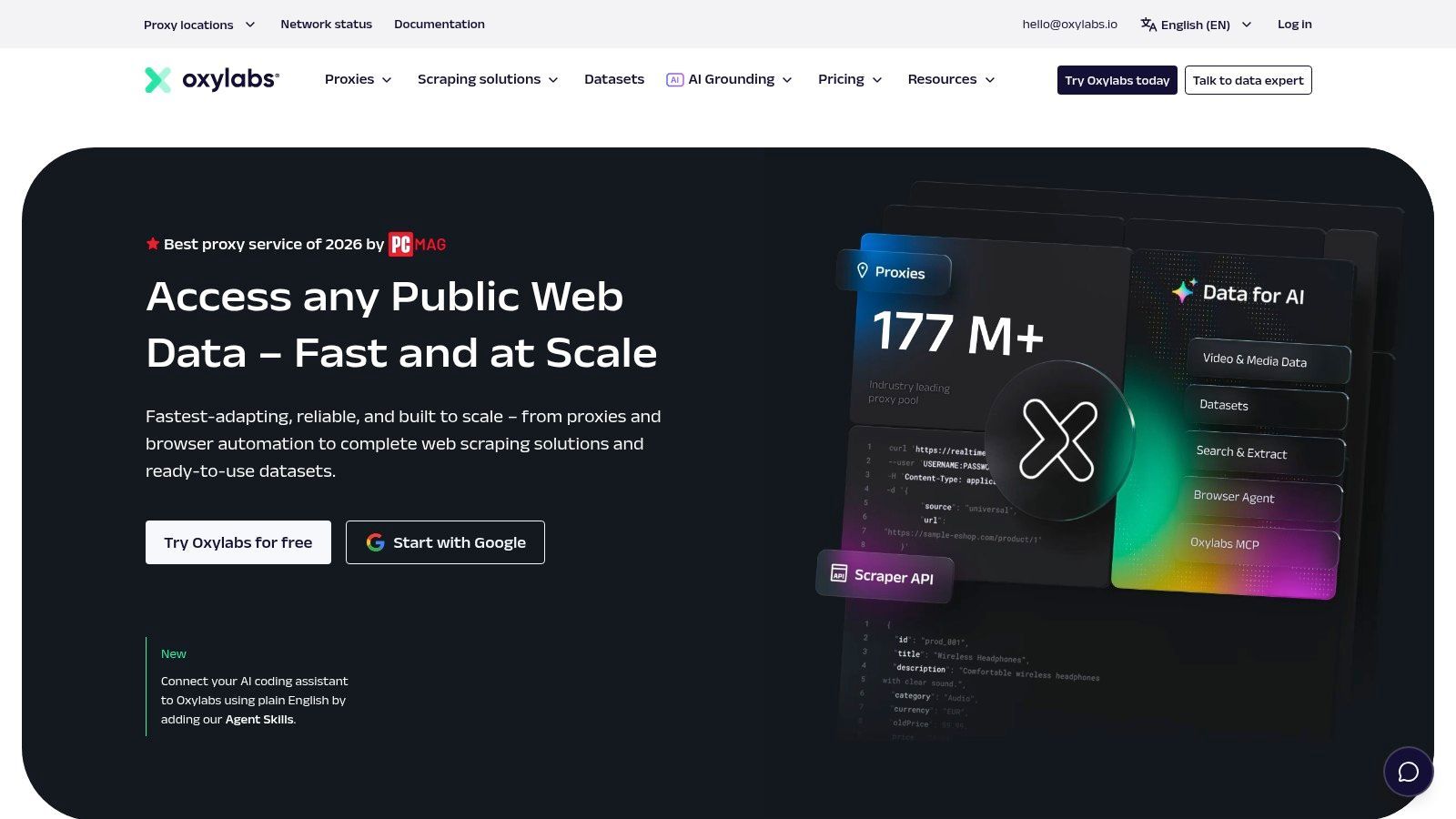
Oxylabs is aimed at enterprise-scale web collection, with particular relevance to e-commerce, product discovery, and price monitoring. Its Web Scraper API combines adaptive parsers, JavaScript rendering, scheduling, batch scraping, and target-specific extractors. The target-specific approach matters because an Amazon-style product record has different quality requirements from a generic page response. Buyers need stable product identifiers, price fields, availability, seller context, and clear handling for missing or changing attributes.
A testing playground and documented extractors can shorten the path from a target list to a first sample. Enterprise support and SLA options add a contractual layer for teams that need escalation rather than a purely self-serve workflow.
The cost driver is the collection path
Oxylabs publishes granular per-result pricing by target and rendering mode. That transparency helps teams build a model, but the result isn't a single universal rate. Costs depend heavily on whether the page needs rendering, how many results are requested, and whether the workflow downloads substantial media. Media downloads are billed by gigabyte, so an e-commerce project that retrieves images or other large assets should model data transfer separately from record extraction.
A practical pilot should compare a rendered and non-rendered version of the same source where possible. It should also measure empty results, stale fields, duplicate records, and retry behavior. A provider can return a technically successful response that still fails the business requirement if the product variant, stock state, or price context is incomplete.
Oxylabs is less suitable when the required deliverable is a ready-made vertical dataset rather than a collection pipeline. It can provide the infrastructure and target extraction, but your team still needs to define normalization, historical retention, and downstream data contracts. Choose it when target coverage and enterprise-scale collection control matter more than receiving a fully managed intelligence product.
5. Apify
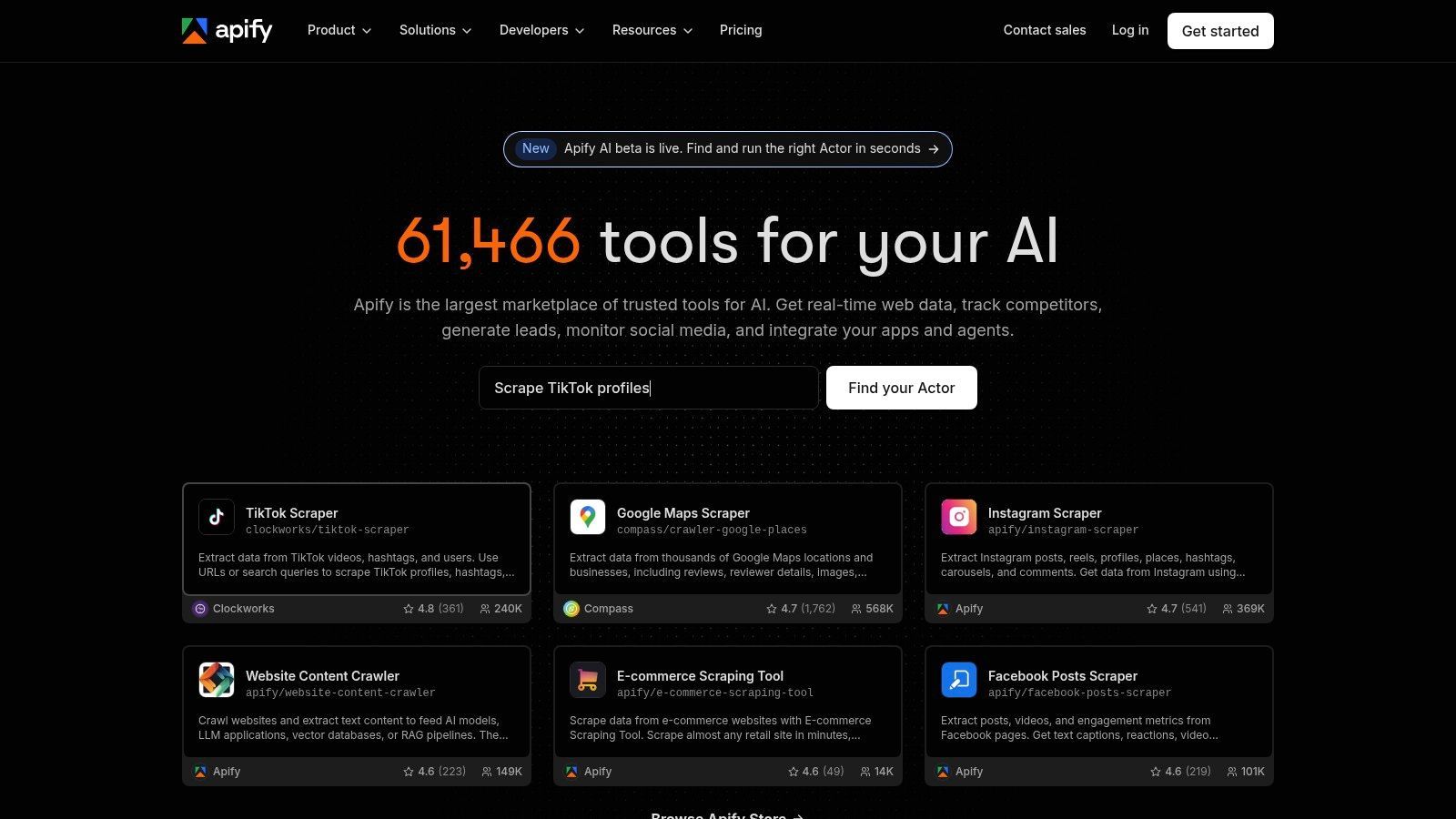
Apify takes a developer-first approach. Its core unit is the Actor, a crawler or automation program that can be built, scheduled, run, and connected to downstream systems. The marketplace offers ready-to-run scrapers, while SDKs and integrations support Playwright and Scrapy workflows. That makes Apify particularly useful when a team wants to move quickly from an idea to a working collector, then decide whether the Actor deserves production hardening.
The platform includes datasets, exports, webhooks, scheduling, integrated proxies, and professional or team support. Those features cover the operational steps that often get missed in a prototype. A crawler needs a trigger, a place for results, delivery behavior, and a failure path. Apify provides those building blocks, but the buyer remains responsible for judging whether an individual Actor is reliable enough for a business-critical source.
Marketplace speed versus production assurance
Many Store Actors use per-result pricing, which can lower the barrier to testing. Apify also offers a free plan for evaluating the platform. The complication is billing composition. Platform usage credits and individual Actor fees can interact, so a simple per-result estimate may not represent the complete cost of a scheduled workflow.
Actor quality varies by publisher. Review the source code or documentation where available, inspect update history, and run the same input repeatedly. Check whether the output includes provenance, timestamps, stable identifiers, and explicit error states. A collector that works for a one-time export may not be appropriate for continuous ingestion.
Practical rule: Treat a marketplace Actor as an implementation candidate, not as a verified data product. Your acceptance test should cover source changes, empty pages, duplicates, rate limits, and recovery after a failed run.
Apify is a strong fit for teams with engineering capacity and changing requirements. It is less attractive if the organization wants a normalized dataset with minimal responsibility for crawler maintenance. In that case, a structured feed or managed intelligence provider may create a cleaner ownership boundary.
6. Webz.io
Webz.io delivers structured feeds from open web content, including news, blogs, forums, and social discussions. Its value is speed to monitored content. A team that needs query filters, multilingual coverage, and a documented API can begin with a feed instead of building discovery, crawling, parsing, deduplication, and language handling from the ground up.
The platform also offers a separate dark-web API for monitoring forums, marketplaces, and channels. That is a specialized use case for threat intelligence and risk monitoring, not a general substitute for product-page extraction. Buyers should define the source classes they need before comparing Webz.io with a web scraper. The wrong comparison can make a structured content feed look weak because it isn't designed to return arbitrary page fields.
Feed delivery and coverage boundaries
Self-service onboarding and a documented free tier support early evaluation. High-volume customers can request customized feeds and premium support. Advanced and dark-web access is generally handled through sales, so the commercial process may be more involved than a self-serve crawler subscription.
The integration work shifts from scraping mechanics to feed governance. Your team still needs to manage query design, duplicate handling, article updates, relevance thresholds, language normalization, and retention. Test whether the feed contains the fields your NLP or monitoring pipeline consumes, rather than assuming that broad source coverage guarantees useful records.
Webz.io is best for near-real-time content monitoring, media intelligence, discussion tracking, and threat-intelligence workflows. It isn't designed as a general product-page scraper. That limitation is a feature of its specialization, not a defect, provided the contract specifies source coverage, freshness expectations, delivery intervals, and correction behavior.
7. Coresignal
Coresignal provides public business datasets rather than a general-purpose crawling toolkit. Its focus is company firmographics, employee information, and job postings, with delivery through APIs, flat files, and data-explorer workflows. That makes it relevant to B2B enrichment, recruiting intelligence, account research, and machine-learning pipelines that need records organized around companies and people rather than individual web pages.
The provider offers Clean and Base datasets, with JSONL, Parquet, and CSV delivery. Historical snapshots and employee or record deltas can support longitudinal analysis, while update webhooks help downstream systems react to changes instead of repeatedly reloading the entire dataset. Its stated approach is limited to public web sources, an important boundary for procurement and legal review.
Dataset fit matters more than crawler flexibility
Coresignal's strength is preparation. Deduped records, metadata, traceability, and multiple delivery options reduce the amount of entity cleanup a customer must build internally. A data team can choose files for bulk modeling, APIs for application lookups, or webhooks for updates. The tradeoff is scope. A company seeking arbitrary page-level content, product attributes, or media files needs another workflow.
Self-serve pricing varies by plan, while enterprise access may require a quote. That makes a representative sample essential. Validate company matching, employee freshness, job-posting coverage, field definitions, and historical behavior against the records your sales, research, or modeling team already trusts.
Coresignal should be evaluated as a business data product. Its commercial value comes from usable, repeatedly updated records, not from giving developers a browser and asking them to construct a pipeline. The contract should state which entities are included, how updates are signaled, how deletions or corrections are represented, and whether your permitted use includes enrichment, analytics, model training, or customer-facing display.
8. Diffbot
Diffbot approaches web collection through entities and relationships. Its Knowledge Graph and automatic extraction APIs are designed to turn public web pages into structured representations such as articles, organizations, products, and other entity types. That changes the integration question. Instead of asking how to write a spider for every site, a team can ask whether Diffbot's schema captures the entities, attributes, and stable identifiers needed by its search, NLP, or analytics system.
The Knowledge Graph uses DQL for querying, while the Crawl API can structure broader site content. JSON and CSV exports support downstream processing, and stable entity IDs are useful when records need to be reconciled over time. Automatic extraction can reduce site-specific parsing work, particularly for teams that don't want to maintain a large collection of custom selectors.
Semantic structure creates a different tradeoff
Diffbot is optimized for structured entities and semantic retrieval, not unrestricted HTML scraping. If your application needs an unusual page element, a precise visual layout, or a source-specific field absent from the extraction model, a conventional crawler may offer more control. Conversely, if the problem is entity resolution across many pages, the graph model may eliminate substantial parsing and reconciliation work.
Credit-based billing can initially feel opaque. Model cost using the exact API calls, crawl depth, query pattern, and export behavior in your pilot. Also verify how the provider represents missing values, changed entities, source timestamps, and conflicting attributes.
Diffbot fits teams building information retrieval, knowledge systems, market maps, and analytical datasets. It isn't a direct substitute for media ingestion or retail intelligence. The strongest reason to choose it is the entity-centric output, especially when stable IDs and relationships are more valuable than raw page snapshots.
9. DataWeave
DataWeave sells managed retail and e-commerce intelligence rather than a general web-scraping environment. Its products cover competitive pricing, promotions, availability, stockouts, assortment, and content compliance. Retailers and brands receive normalized, decision-oriented outputs instead of assembling their own collection, SKU matching, retailer-specific parsers, and dashboards.
That specialization changes the buying conversation. The question isn't whether your developers can make requests to a website. It's whether the delivered records represent the right products, variants, retailers, promotions, and availability states well enough for pricing, merchandising, or marketplace decisions. SKU-level normalization and domain-specific quality controls can matter more than access to a flexible browser.
Managed output and procurement risk
DataWeave provides dashboards and exports for modeling and business intelligence. That reduces internal operational overhead, but it also places more dependence on the vendor's definitions. Before signing, ask how the service handles product matching, out-of-stock states, promotional pricing, retailer changes, and corrections. Request sample records for the exact categories and retailers that drive the business decision.
Pricing and engagements are sold through sales, with no public pricing listed in the brief. The proposal should therefore identify the billing unit, coverage assumptions, refresh schedule, export limits, implementation fees, and support obligations. A managed product may look expensive beside a raw scraper until internal labor, QA, and maintenance are included. It may also be poor value if the business needs only a narrow page-level signal that an internal team can safely collect.
DataWeave is appropriate when the desired output is retail intelligence, not collection infrastructure. Its main limitation is the same specialization that creates its value. It won't replace a broad crawler, a business-record API, or a media-download service.
10. Dataprovider.com
Dataprovider.com offers a broad inventory of classified domains and site-level signals. Its data covers firmographic and technology attributes, site categorization, security indicators, traffic proxies, and other enrichment points, delivered through a REST API or data-warehouse connectors for Snowflake, BigQuery, and Databricks. That delivery model suits market sizing, technology-adoption research, account enrichment, and lakehouse analytics.
The important distinction is abstraction. Dataprovider.com isn't primarily returning every page element from a selected site. It gives teams structured signals about domains, which can be queried programmatically or loaded directly into an analytical warehouse. That can remove the need to operate a large discovery crawler when the research question concerns the web as a population of businesses and technologies.
Warehouse delivery versus page-level control
The provider describes signals across 200+ data points, including technology stack and security-related attributes. That number comes from the product brief and should be validated against the specific package under consideration. A pilot should test classification accuracy, field definitions, domain matching, update timing, and how the platform treats parked, redirected, multilingual, or inactive sites.
Warehouse connectors can simplify deployment because analysts and data scientists can work with the output inside existing governance and modeling environments. They don't, however, guarantee that the abstracted signal answers a page-level question. If your team needs the exact text, image, HTML structure, or media file from a target page, this is the wrong layer.
Pricing and access are handled through sales, so request a sample before modeling value. Dataprovider.com makes the most sense when the unit of analysis is a domain, company, or technology signal. It is less suitable when the workflow depends on bespoke extraction from individual pages.
Top 10 Data Collection Firms Comparison
| Provider | Core Features | Quality ★ | Price/Value 💰 | Target 👥 | Unique Selling Points ✨ |
|---|---|---|---|---|---|
| YouTube Download API 🏆 | MP4 (1080p–144p), MP3, async job flow, trimming, multi‑audio, error taxonomy | ★★★★☆ 99.9% reported uptime; instant metadata; self‑healing retries | 💰 Starter $99/mo (1k downloads, 400GB); Growth $399; Scale $1,499; enterprise & free trial | 👥 SaaS teams needing reliable, scalable YouTube ingestion/redistribution | ✨ Direct CDN download URLs, centralized bot handling, deterministic error codes, queue scaling |
| Bright Data | Proxies, browser/unlocker, Web Scraper API, parsing templates | ★★★★ Mature docs & tooling; enterprise SLAs available | 💰 Pay‑for‑success pricing; free trial tier; can be costly for media | 👥 Teams needing robust unblocking & large-scale web extraction | ✨ High-fidelity browser unlocker + structured output templates |
| Zyte (Scrapinghub) | Auto tech selection (datacenter/residential/rendering), managed extraction, Scrapy Cloud | ★★★★ Auto mode improves success & cost efficiency | 💰 Pay‑as‑you‑go per site; $5 free credit; pricing can be complex | 👥 Mixed-portfolio scrapers that need cost-efficient stack selection | ✨ Chooses cheapest rendering per target; managed extraction option |
| Oxylabs | Web Scraper API, adaptive parsers, headless rendering, target extractors | ★★★★ Enterprise-grade SLAs and documentation | 💰 Transparent per-target rates; media billed per GB (can add up) | 👥 Large e‑commerce/price‑tracking teams | ✨ Target-specific extractors, granular pricing for heavy workloads |
| Apify | Actors marketplace, SDKs (Playwright/Scrapy), scheduling, webhooks | ★★★ Quick prototyping; marketplace variability | 💰 Free plan + per-Actor pricing; credits + per-Actor fees | 👥 Developers prototyping crawlers or automations | ✨ Large marketplace of ready-to-run Actors for fast MVPs |
| Webz.io | Structured feeds (news/forums), dark‑web API, multilingual coverage | ★★★★ Fast near‑real‑time feeds for monitoring | 💰 Free tier; tailored enterprise plans for high volume | 👥 Threat intel, media monitoring, NLP/analysis teams | ✨ Dark‑web API and curated, enriched content feeds |
| Coresignal | Clean/Base business datasets (JSONL/Parquet/CSV), APIs, webhooks | ★★★★ Purpose-built, deduped datasets for ML/enrichment | 💰 Self‑serve + enterprise quotes; volume pricing | 👥 Teams needing firmographics, employee/job signals for ML | ✨ Large, continuously updated business datasets with deltas |
| Diffbot | Knowledge Graph (10B+ entities), automatic extraction APIs, DQL | ★★★★ Entity-centric extraction for NLP/search | 💰 Credit-based billing; enterprise options (can be opaque) | 👥 Teams needing entity-level enrichment & semantic search | ✨ Global Knowledge Graph + DQL for entity queries |
| DataWeave | Retail/e‑commerce feeds: pricing, availability, assortment, compliance | ★★★★ SKU-level normalization, retailer-focused accuracy | 💰 Sold via sales; custom enterprise engagements | 👥 Retailers & brands needing decision-ready competitive intelligence | ✨ Domain-specific, curated retail insights and dashboards |
| Dataprovider.com | Full-web inventory, firmographics, tech signals, warehouse connectors | ★★★ Broad domain coverage; easy warehouse integration | 💰 Sales-handled pricing; samples recommended | 👥 GTM, market sizing, tech-adoption researchers | ✨ Large-scale domain crawl with Snowflake/BigQuery connectors |
Turn the Shortlist Into a Testable Data Contract
A shortlist becomes useful only when it produces a controlled test. Begin by writing down the sources, fields, freshness, and permitted uses your system requires. “Web data” is too broad to support procurement. State whether you need API collection, rendered scraping, a structured content feed, media ingestion, or managed intelligence, then remove vendors whose delivery model doesn't match that classification.
Next, request representative samples. Include easy and difficult sources, current and stale records, large and small payloads, multilingual content where relevant, and the exact media or entity types that will reach production. Measure completeness, malformed responses, duplicate rates, missing identifiers, freshness, and error classification. Don't accept a clean demonstration based on a handpicked source as evidence that the workflow will remain reliable.
Cost modeling must use the provider's actual billing unit. Depending on the vendor, that may be a download, gigabyte, successful result, browser operation, credit, record, API call, file delivery, or managed engagement. For YouTube Download API, model both download credits and gigabytes because a low request count can still produce substantial media volume. For web scraping platforms, separate lightweight requests from rendered browser work. For managed products, include implementation, export, support, and correction terms.
A practical contract should cover:
- Permitted sources and rights: Identify allowed domains, access rights, content restrictions, geographic limits, and approved uses, including analytics, enrichment, model training, display, or redistribution.
- Schema and delivery: Specify field definitions, JSON, CSV, JSONL, Parquet, or warehouse delivery, encoding, versioning, timestamps, identifiers, and backward-compatibility rules.
- Freshness and completeness: Define refresh expectations, acceptable missing fields, coverage boundaries, duplicate handling, and how the provider reports source outages.
- API behavior: Record rate limits, pagination, authentication, batch limits, webhooks, polling behavior, retry rules, idempotency, and terminal error codes.
- Provenance and corrections: Require source URLs or source identifiers where appropriate, collection timestamps, transformation notes, correction windows, and deletion or suppression handling.
- Security and privacy: Document retention, encryption, access controls, subprocessors, incident notification, cross-border transfer terms, and data deletion at termination.
- Support and remedies: Set response times, escalation paths, SLA measurement, service credits or other remedies, maintenance notices, and responsibilities when a target changes.
- Exit terms: Define export rights, final delivery format, deletion certification, credential revocation, and whether historical records remain usable after termination.
Quality deserves its own acceptance test. Compare the provider's output with a manually verified sample, then rerun the test after a source change or scheduled update. Check whether the same entity keeps the same identifier, whether corrections overwrite or version prior values, and whether failed requests are distinguishable from empty results. A successful HTTP response isn't proof of a valid record.
Run a limited pilot before committing to volume. Set a fixed source set, a fixed evaluation period, and explicit pass conditions for completeness, freshness, error recovery, delivery latency, and total cost. Infrastructure providers such as Bright Data, Zyte, Oxylabs, and Apify leave more control with engineering. Structured and managed providers such as Webz.io, Coresignal, Diffbot, DataWeave, and Dataprovider.com reduce parts of the collection burden by supplying feeds, entities, or domain intelligence. The right choice depends on which responsibility your team is prepared to own.
YouTube Download API belongs in that pilot only when the workflow involves lawful YouTube media retrieval and asynchronous delivery of MP4 or MP3 assets. Validate restricted-content handling, format needs, clipping behavior, CDN delivery, error taxonomy, and credit usage against real application requests. That test will tell you more than a generic vendor ranking.
If your workflow needs lawful YouTube media ingestion without maintaining cookies, proxies, bot-detection logic, or extractors, YouTube Download API provides an asynchronous REST flow with metadata, direct CDN download URLs, MP4 and MP3 output, clipping, and machine-readable errors. Test it against your real ingestion, transcription, analysis, or content-automation pipeline before scaling the contract.